15 Biggest Hedge Funds in the USA (2026): AUM, Strategies, Track Records
The biggest hedge funds in the United States manage tens of billions of dollars each, employ thousands of people, and move markets when they trade. Yet almost nobody can invest in them, and almost every "biggest hedge funds" list gives a different order. This guide ranks the 15 largest US-based hedge fund firms using the most recent figures we could find (mid-2026), explains what each one actually does, and is honest about where the numbers disagree.

Key takeaways
- No single ranking is "correct." Bridgewater, Millennium, Elliott and Citadel trade places depending on the source, the date and whether you count hedge-fund assets or the whole firm.
- The top of the list is crowded. Roughly $90 billion to $100 billion sits at the very top, then a gap, then a cluster of firms in the $60 billion to $80 billion range.
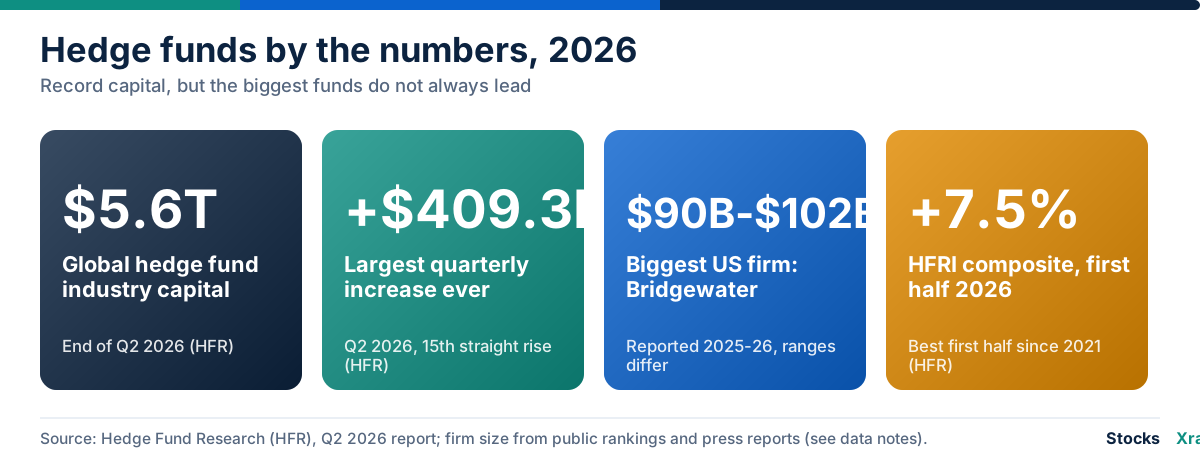
- The industry is at a record size. Industry-wide capital reached about $5.6 trillion in the second quarter of 2026, according to Hedge Fund Research (HFR).
- Size is not skill. Assets reflect fundraising, track record, capacity decisions and leverage. A firm can be huge and have a poor year, or small and have a great one.
- Ordinary investors can learn from the firms without copying them. Quarterly 13F filings show some holdings, but with a delay and with important gaps (see the section on 13F filings below).
The 15 biggest US hedge funds at a glance
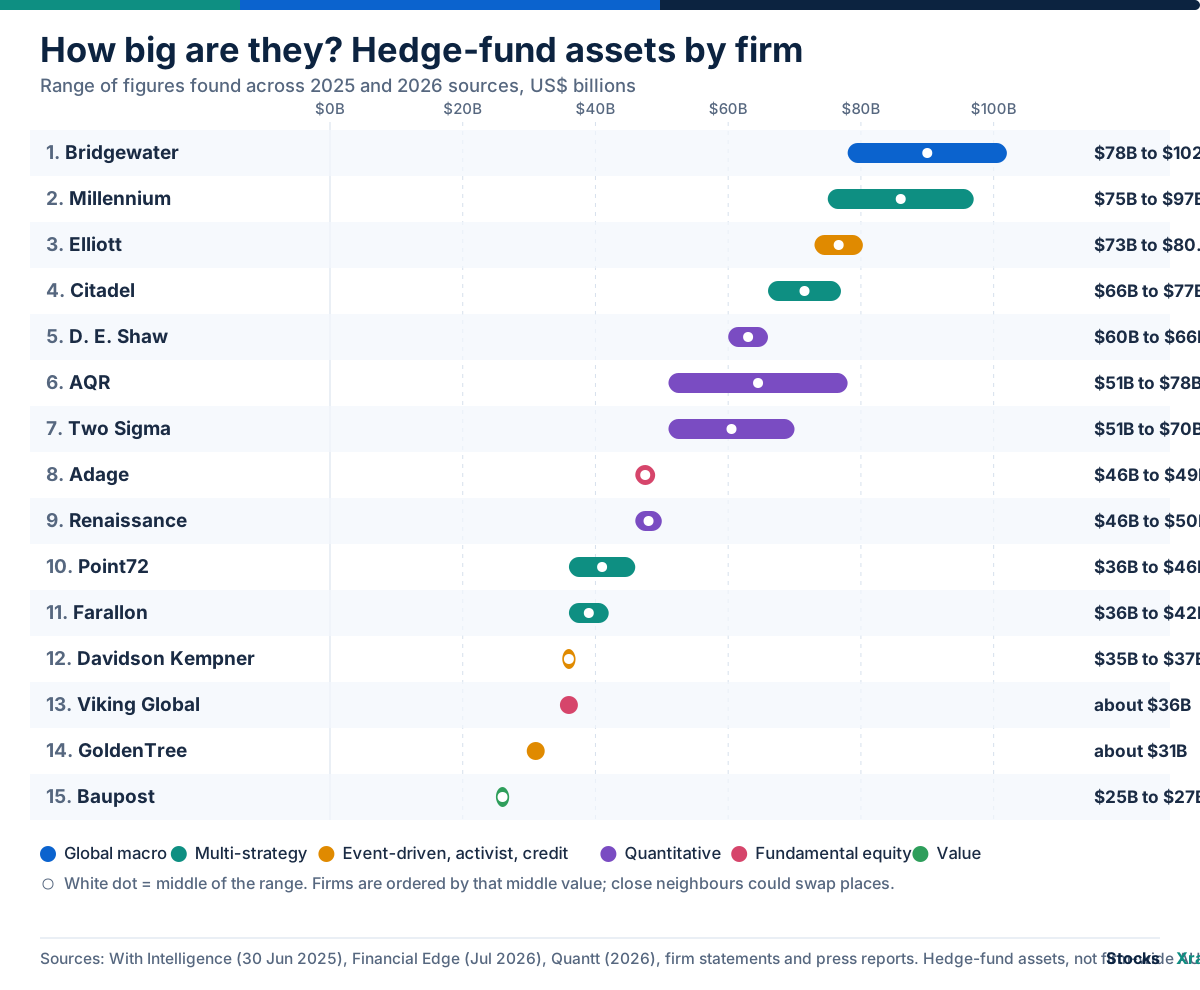
The table shows the range of hedge-fund asset figures we found for each firm across 2025 and 2026 sources. The firms are ordered by the middle of that range. Where ranges overlap, the order is a judgement call and could reasonably change.
| # | Firm | Based in | Founded | Main style | Approx. hedge-fund assets |
|---|---|---|---|---|---|
| 1 | Bridgewater Associates | Westport, Connecticut | 1975 | Global macro | $78B to $102B |
| 2 | Millennium Management | New York | 1989 | Multi-strategy (platform) | $75B to $97B |
| 3 | Elliott Investment Management | West Palm Beach, Florida | 1977 | Activist, event-driven, credit | $73B to $80B |
| 4 | Citadel | Miami | 1990 | Multi-strategy | $66B to $77B |
| 5 | D. E. Shaw | New York | 1988 | Quantitative plus fundamental | $60B to $66B |
| 6 | AQR Capital Management | Greenwich, Connecticut | 1998 | Quantitative, factor investing | $51B to $78B |
| 7 | Two Sigma | New York | 2001 | Quantitative, data science | $51B to $70B |
| 8 | Adage Capital Management | Boston | 2001 | Fundamental equity | $46B to $49B |
| 9 | Renaissance Technologies | East Setauket, New York | 1978 | Quantitative | $46B to $50B |
| 10 | Point72 Asset Management | Stamford, Connecticut | 2014 | Multi-strategy | $36B to $46B |
| 11 | Farallon Capital | San Francisco | 1986 | Multi-strategy, event-driven | $36B to $42B |
| 12 | Davidson Kempner | New York | 1983 | Event-driven, credit | $35B to $37B |
| 13 | Viking Global Investors | Connecticut | 1999 | Fundamental long/short equity | about $36B |
| 14 | GoldenTree Asset Management | New York | 2000 | Credit | about $31B (hedge funds) |
| 15 | Baupost Group | Boston | 1982 | Value investing | $25B to $27B |
Figures are in US dollars and are rounded. "B" means billion.
How we ranked them, and why the numbers disagree
Hedge funds are private. They do not publish audited, comparable assets-under-management (AUM) figures on a common date, so every ranking is an estimate. We took figures from several public rankings published in 2025 and 2026 (including With Intelligence's Billion Dollar Club data as of 30 June 2025, and 2026 compilations from Financial Edge and Quantt), from firms' own statements where they exist, and from press reports. For each firm we show the range, and we ordered the list by the middle of the range.
Why do the sources disagree? Five reasons come up again and again.
- Hedge-fund assets versus firm-wide assets. Some firms also run mutual funds, long-only strategies or private equity. AQR's firm-wide assets were reported at about $128 billion in 2025, but its hedge-fund assets in some rankings are far lower. GoldenTree manages more than $65 billion across credit strategies, but only part of that sits in hedge funds.
- Dates. A figure from June 2025 and one from September 2026 can differ by tens of billions at a fast-growing firm. Millennium's reported figure rose from the mid-$70 billions in some 2025 lists to about $97 billion in September 2026.
- Net versus gross. Rankings of hedge-fund assets are usually net of borrowing. A firm that uses a lot of leverage controls far more market exposure than its AUM suggests, which matters for the multi-strategy platforms.
- Returned profits and closed funds. Citadel returned about $5 billion of 2025 profits to clients, which lowered its assets. Renaissance's best-known fund, Medallion, is closed to outsiders, so a headline figure says little about it.
- Self-reporting. Firms report on their own schedules, and a figure can be months old when you read it.
What we left out. This list covers US-based firms. Big non-US hedge fund managers such as Man Group, Marshall Wace, TCI, Brevan Howard and Qube Research & Technologies (all London-based) are excluded. So are the hedge-fund units of giant asset managers such as BlackRock, Goldman Sachs Asset Management, Wellington and PIMCO, which are better understood as divisions of larger companies. Balyasny Asset Management (roughly $21 billion in one 2026 list) and ExodusPoint (roughly $12 billion) fall just below the cut.
What is a hedge fund?
A hedge fund is a privately offered investment partnership that pools money from institutions and wealthy individuals and can use a wider toolkit than a typical mutual fund. It can sell stocks short (betting on a fall), borrow to amplify positions, trade derivatives, and invest in assets that are hard to sell quickly. The name comes from the original idea of "hedging" a portfolio against market falls, although many funds today take large directional risks.
Who can invest. In the United States, hedge funds are generally open only to accredited or qualified investors, such as institutions, pension funds, endowments, foundations and high-net-worth individuals. Minimum investments are often large, and investors usually cannot withdraw at will: funds typically use lock-ups and periodic redemption windows.
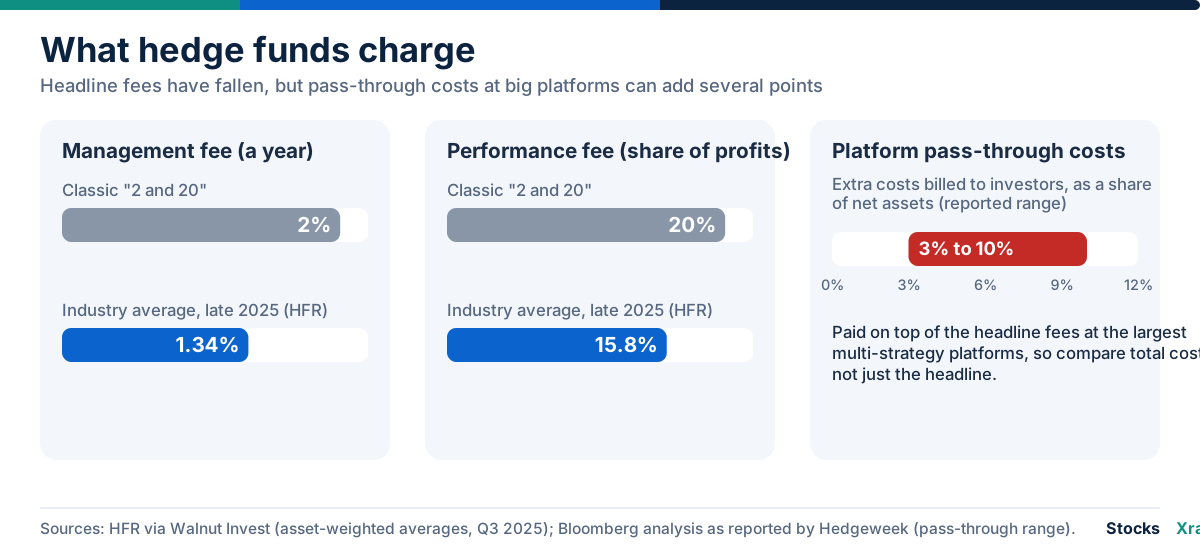
How they are paid. The classic fee was "2 and 20": a 2% annual management fee plus 20% of profits. Industry data from HFR (as of late 2025) put the asset-weighted average at roughly a 1.3% management fee and a 16% performance fee, and the largest multi-strategy platforms often pass extra operating costs through to investors on top. Reporting based on Bloomberg analysis has put those pass-through expenses at roughly 3% to 10% of net assets, so the full cost of a platform fund can be much higher than the headline fees suggest.
How they are regulated. Hedge fund managers register with the SEC as investment advisers and file Form ADV, but the funds themselves are lightly regulated compared with mutual funds, because they are sold only to sophisticated investors.
Hedge funds compared with mutual funds and ETFs.
| Hedge fund | Mutual fund | ETF | |
|---|---|---|---|
| Who can invest | Mostly institutions and accredited investors | Anyone | Anyone |
| Minimum investment | Often $1 million or more | Often a few hundred to a few thousand dollars | The price of one share |
| Selling | Periodic redemption windows, often with lock-ups | Daily, at the end-of-day price | Any time the market is open |
| Short selling and leverage | Widely used | Tightly limited | Limited, apart from specialist funds |
| Fees | Management fee plus a share of profits, sometimes plus pass-through costs | Management fee, often low for index funds | Management fee, often very low |
| Disclosure | Limited: regulators see more than the public | Regular public holdings reports | Daily holdings for most funds |
| Regulation | Light, because investors are sophisticated | Heavy, under US investment company law | Heavy, under US investment company law |
For a plain-English comparison of the retail products, see our guide to ETFs, mutual funds and stocks.
The main hedge fund strategies
The 15 firms below use very different methods. Knowing the families helps you read the profiles.
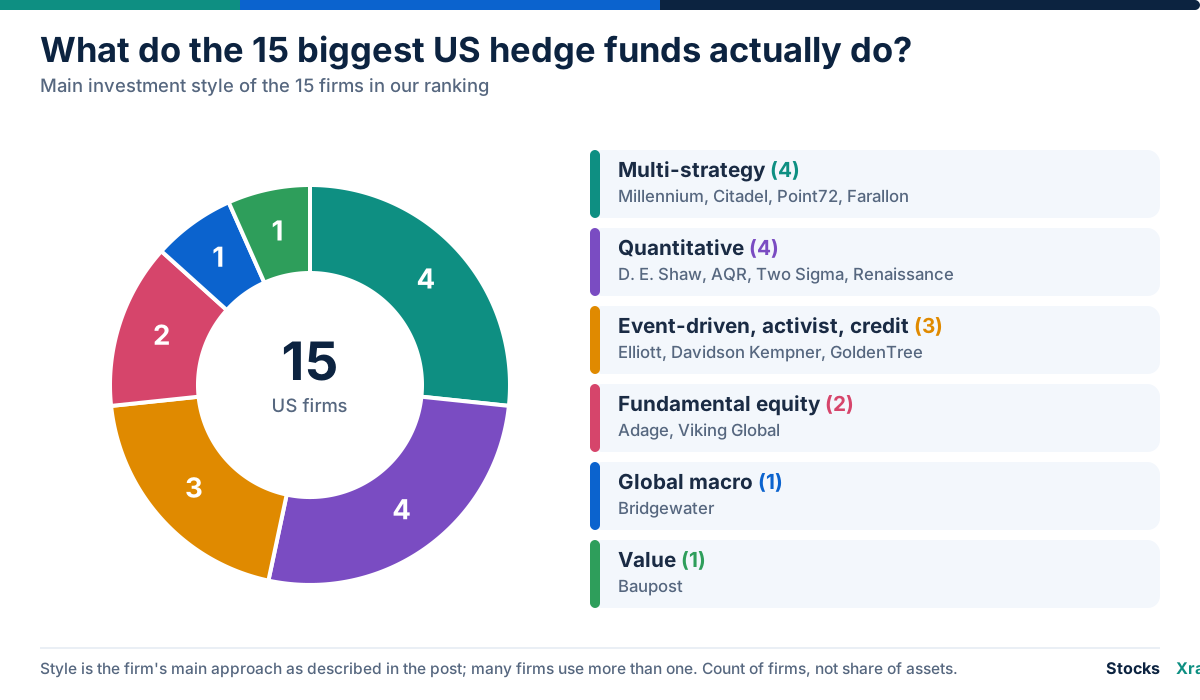
- Global macro. Bets on big economic themes: interest rates, currencies, commodities, inflation, growth. Bridgewater is the best-known example.
- Fundamental long/short equity. Analysts pick stocks they expect to rise (long) and fall (short). Viking Global and Adage are examples.
- Multi-strategy "platform" or "pod" funds. A central firm allocates capital to many independent portfolio-manager teams, each with strict risk limits. Millennium, Citadel and Point72 are the best-known platforms.
- Quantitative and systematic. Computer models, statistics and large data sets drive trading. Renaissance, D. E. Shaw, Two Sigma and AQR belong here.
- Event-driven and activist. Profits from corporate events such as mergers, restructurings and bankruptcies, or from pushing a company to change. Elliott and Davidson Kempner are leading examples.
- Credit and distressed. Invests in bonds, loans and troubled debt. GoldenTree is a credit specialist, and Baupost buys distressed assets alongside its value investing.
- Value investing. Buys assets priced below estimated worth and waits. Baupost is the classic case.
A short history of US hedge funds
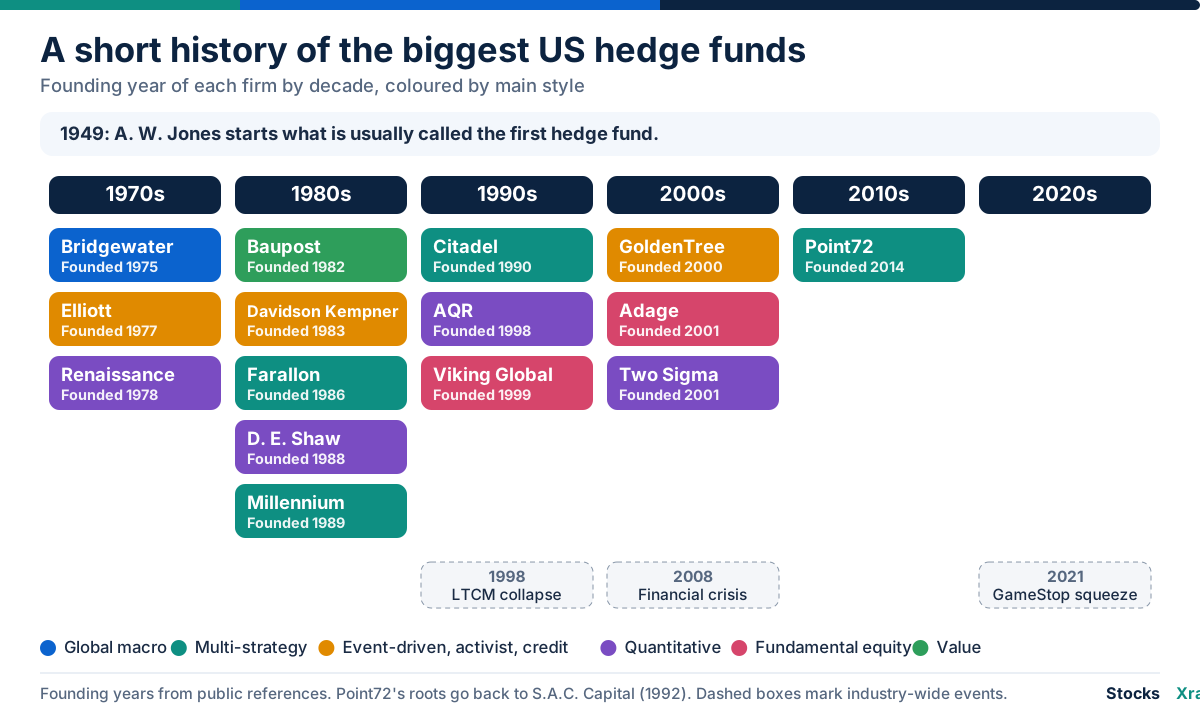
The first hedge fund is usually credited to Alfred Winslow Jones, who in 1949 set up a partnership that combined long and short stock positions with leverage and a profit-sharing fee. The idea stayed obscure for years, until the 1970s and 1980s, when funds run by figures such as George Soros and Julian Robertson showed how large the profits could be. Robertson's Tiger Management became the training ground for the "Tiger Cubs" (Viking's founder is one).
The 1990s brought the quantitative revolution (D. E. Shaw started in 1988 and Renaissance's Medallion fund in the same year) and a warning. In 1998 Long-Term Capital Management, a fund run by famous traders and Nobel-winning economists, collapsed after huge leveraged bets went wrong, and the New York Fed arranged a rescue by Wall Street banks.
The 2008 financial crisis tested the industry again. Many funds lost money and several restricted withdrawals. Citadel barred investors from withdrawing for ten months, and its biggest funds finished 2008 down about 55% before rebounding about 62% in 2009. D. E. Shaw also temporarily halted withdrawals.
The 2010s and 2020s belonged to the platform model. Millennium, Citadel and Point72 grew by hiring many specialist teams and managing risk centrally. In 2021 a flood of retail buying in GameStop forced the short-selling fund Melvin Capital into an emergency rescue by Citadel and Point72. By mid-2026, HFR reported industry capital of $5.6 trillion, the highest on record.
The 15 biggest hedge funds in the USA
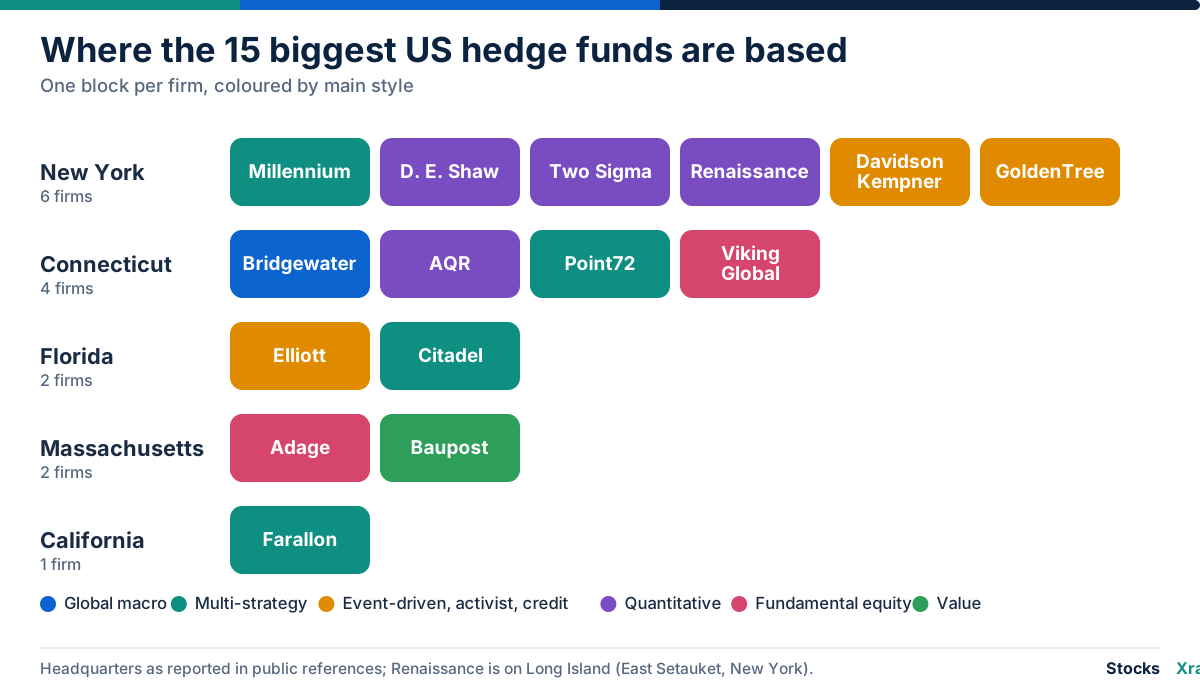
Before the profiles, a quick look at where these firms are based and who they are.
1 Bridgewater Associates

Bridgewater started in 1975 in Ray Dalio's Manhattan apartment and moved to Connecticut in 1981. It runs systematic macro strategies: Pure Alpha, its flagship, and All Weather, a risk-balanced portfolio launched in 1996, are its best known. In 2023 it created AIA Labs, which combines machine learning and large language models, and its AIA Macro fund has been reported at about $4.5 billion.
Dalio gave up the CEO title in 2011, retired as co-CEO in 2017, and by 2024 had sold his remaining stake and left the board. Nir Bar Dea became sole CEO in March 2023 and Bob Prince became board chair in January 2026. The firm has about 1,300 employees and is famous for its "radical transparency" culture and for the Principles handbook, which critics have likened to a cult, a description Dalio rejects.
Bridgewater does not publish returns, so figures come from people familiar with the firm. Pure Alpha was reported up about 33% in 2025, its best full year. In the first half of 2026 it was reported up about 8%, which trailed the S&P 500's gain over the same period. Bridgewater has named modern mercantilism, concentration of US portfolios and artificial intelligence as its main research themes for 2026.
Press reports say Bridgewater has kept Pure Alpha closed to new money, so growth in the firm's total comes from other strategies.
2 Millennium Management
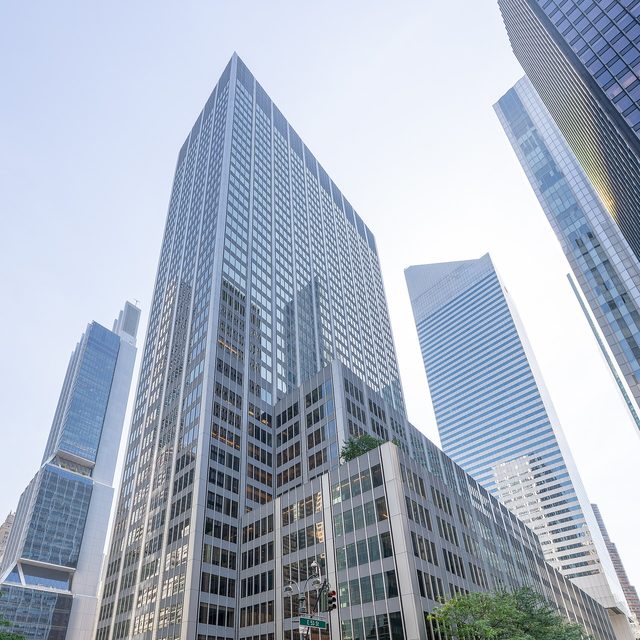
Englander started Millennium in 1989 with about $35 million. Today it is the template for the "pod shop": roughly 280 investment teams, each allocated capital by the central firm and each held to tight loss limits. It employs more than 6,800 people in 18 primary offices, including London, Hong Kong, Dubai and Tokyo.
Investors keep backing the model. Public references report that Millennium received more than $30 billion of commitments in September 2026 against a target of $20 billion, and that about $22 billion was finalised on 1 October. It also raised $4.1 billion in 2019 after a two-year pause in taking new money.
Press reports describe an average return of around 14% a year since inception and only one losing year, 2008. The firm suffered a loss of roughly $900 million in March 2025 after missed bets on index rebalancing, which shows that even platforms stumble.
Millennium's reported assets understate its market footprint because the platform uses leverage, and pass-through expenses can add substantially to what investors pay.
3 Elliott Investment Management
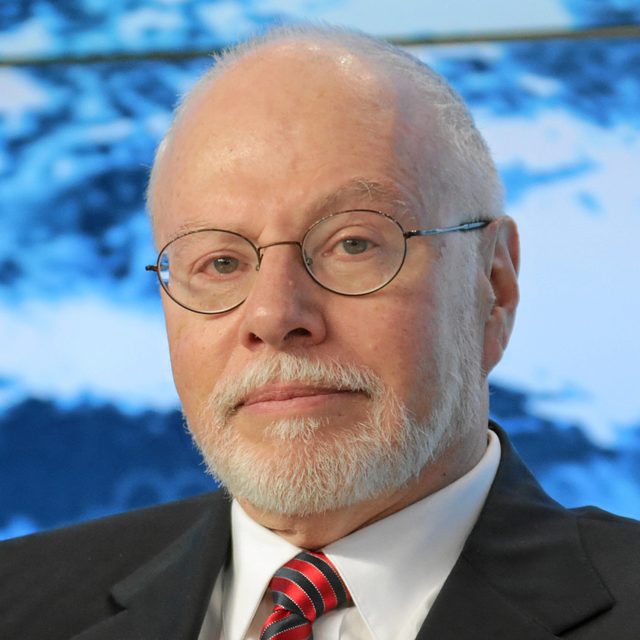
Paul Singer started Elliott in January 1977 with $1.3 million from friends and family. It began in convertible arbitrage, moved into distressed debt after the 1987 crash and the early-1990s recession, and later became one of the world's best-known activist investors. Singer and Jonathan Pollock are co-CEOs, and the firm moved its headquarters from New York to West Palm Beach in 2020. It employs roughly 670 people in New York, London, Tokyo and elsewhere.
Elliott's name is linked to campaigns at large companies including AT&T, Twitter, Southwest Airlines, BP, PepsiCo and Toyota Industries. It is also known for its sovereign-debt cases. It won a $58 million award in Peru after buying about $20 million of defaulted debt, and it pursued Argentina through its NML Capital arm, including the 2012 seizure of a naval training ship in Ghana.
Press reports say Elliott raised $13 billion from private investors in 2022 and a further $7 billion in 2023, and in late 2025 was reported to be seeking up to $7 billion more.
Elliott's 13F filing shows only a fraction of its business. One filing listed about 30 US equity positions worth roughly $17.6 billion, a small part of its $80 billion, because credit, private investments and non-US holdings are not included.
4 Citadel
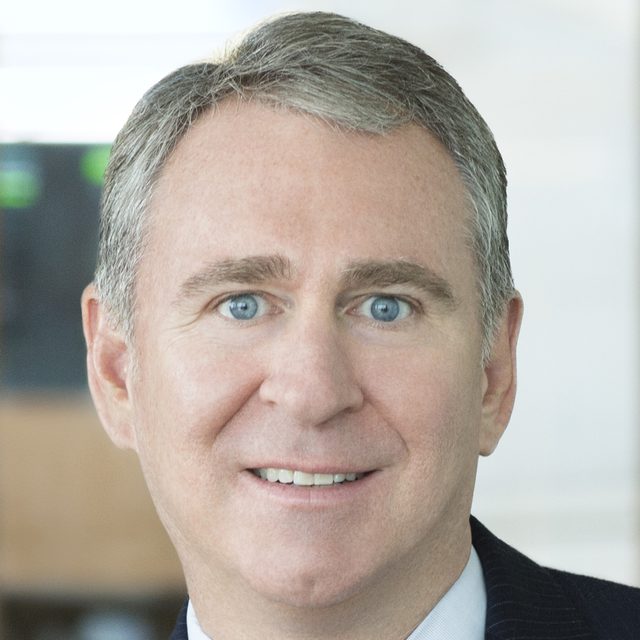
Ken Griffin started Citadel in Chicago in 1990, originally as Wellington Financial Group, named after its flagship fund. The firm moved its headquarters to Miami after announcing the decision in June 2022. Griffin owns about 85%. Citadel's hedge fund business is separate from Citadel Securities, the market maker, although both are owned by Griffin.
The firm runs several funds, including the flagship Wellington multi-strategy fund, Global Equities, Tactical Trading, and a fixed income and macro fund. It employs more than 3,100 people.
Citadel is best known for the size of the profits it earns. The firm returned a record $16 billion to clients in 2022 and about $7 billion in 2023. Press reports said the Wellington fund gained about 10.2% in 2025 and has averaged about 19% a year since 1990, though Citadel does not publish its returns. Public references put its lifetime net gains for investors at about $90 billion as of December 2025. The low points were 2008, when its biggest funds fell about 55%, and the ten-month freeze on withdrawals that followed.
Citadel's reported assets dipped in 2026 after the firm returned roughly $5 billion of profits to clients to keep the funds at a size it considers manageable. Different sources give figures from $66 billion to $77 billion.
5 D. E. Shaw

David Shaw, a former Columbia University computer science professor with a Stanford PhD, founded the firm in 1988, and it began investing in 1989 with $28 million. Early strategies were market-neutral trades such as statistical arbitrage, convertible-bond arbitrage and fixed-income trading. Today the firm combines quantitative models with fundamental research and also makes private investments in areas including technology and renewable power. It employed about 2,500 people in 2022 and is based at Two Manhattan West.
The firm has had both great and hard years. It earned a 26% net return in 1994, took heavy losses in the 1998 Russian crisis, and lost money in 2008, when its assets fell from a high of about $34 billion in 2007 to about $21 billion in 2010, and it temporarily halted withdrawals. David Shaw stepped back from day-to-day management in 2002. Lehman Brothers bought a 20% stake in 2007, and Hillspire, Eric Schmidt's family office, bought it in 2015.
In 2023 the firm agreed to pay $10 million to settle SEC charges over whistleblower protection rules, and in 2022 a FINRA panel awarded $52 million to a former employee in a defamation case.
6 AQR Capital Management
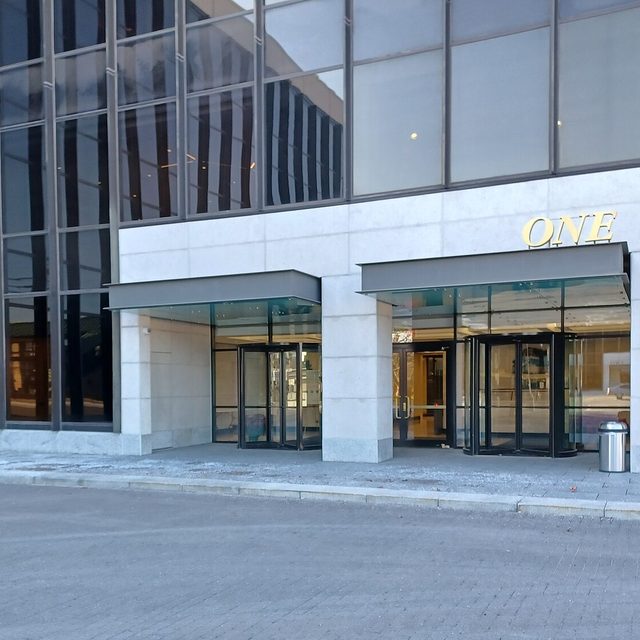
AQR is the most academic of the large hedge funds. Its founders left Goldman Sachs to start it, and three of them met in the University of Chicago's PhD program. As of 2016, about half of employees held advanced degrees, including 52 PhDs. The firm built its reputation on factor investing, the idea that value, momentum, defensive and carry characteristics explain long-run returns, and it offers risk parity, managed futures and "alternative premia" strategies. It launched alternative mutual funds in 2009.
AQR's assets have swung widely. Public references show roughly $20 billion in 2009, a peak of about $190 billion around 2018 and 2019, a fall to about $99 billion at the end of 2023, and a recovery to about $128 billion in 2025. Annual profit fell 34% in 2018 and the firm cut jobs in early 2019. Press reports said several funds gained close to 10% in the first quarter of 2025.
AQR is a good example of why definitions matter. Its hedge-fund assets are much smaller than its total, because the total includes liquid alternative funds available to ordinary investors.
7 Two Sigma
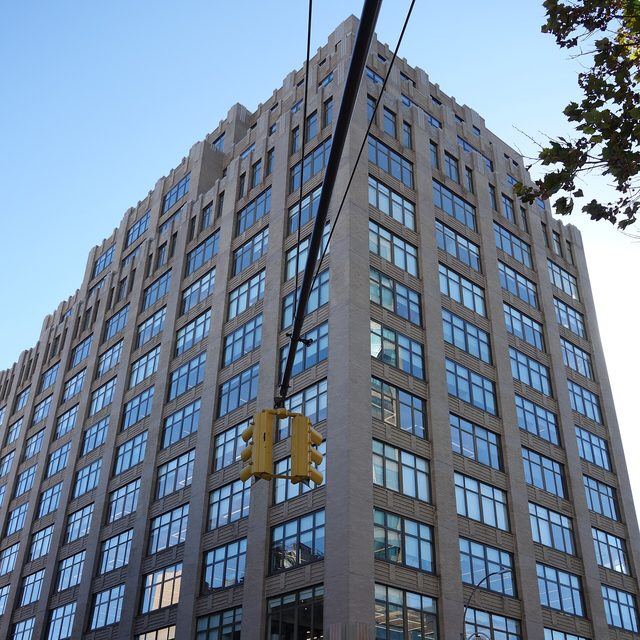
Two Sigma describes itself as a technology company that happens to invest. It uses machine learning, artificial intelligence and distributed computing to build trading strategies, and it employs about 2,000 people.
The firm has had a turbulent few years. In 2023 it disclosed discord between its founders, and in August 2024 Overdeck and Siegel stepped down as co-CEOs, replaced by Carter Lyons and Scott Hoffman; both founders remain co-chairmen. In October 2023 the SEC opened an investigation after a senior vice president made unauthorised changes to trading models; Two Sigma fixed the affected accounts and repaid client losses. In September 2025 the US Department of Justice indicted a former researcher, alleging about $165 million in client damage.
The episode is a reminder that model-driven funds have operational risks, not only market risks: a change to a model can move many portfolios at once.
8 Adage Capital Management
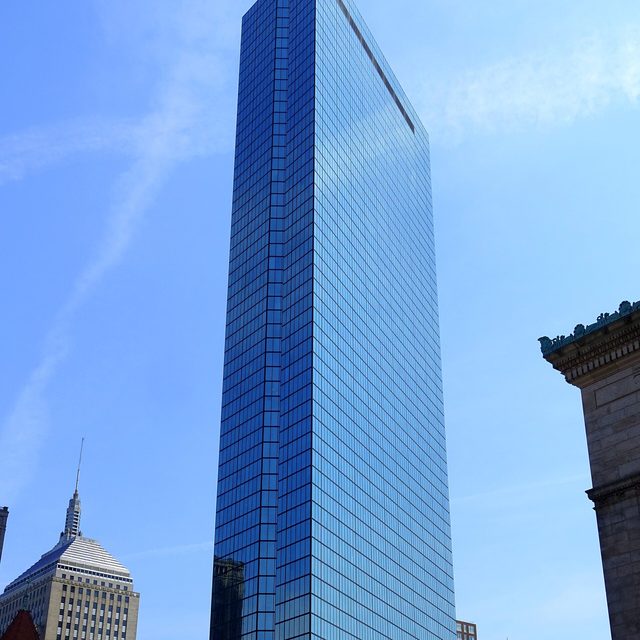
Gross and Atchinson met as investment analysts at the Harvard endowment in the mid-1980s and left to found Adage. Harvard became the anchor investor, putting in $1.8 billion on day one in return for an agreement, since expired, that paid the university 10% of Adage's earnings. The firm invests mostly in the S&P 500 universe using fundamental analysis and also holds private stakes in start-ups such as GitLab and Gopuff.
Adage is lean: public references put its headcount at about 53 in 2023, remarkably small for a firm of its size. It manages money mainly for tax-exempt institutions, and it has a rare fee policy of partially rebating prior-year fees when it trails the S&P 500.
Public references cite an annualised return since inception of about 9.7%, against 6.4% for the S&P 500, with a weak patch of 1.1% for one 12-month period. Adage is known for being extremely private.
9 Renaissance Technologies
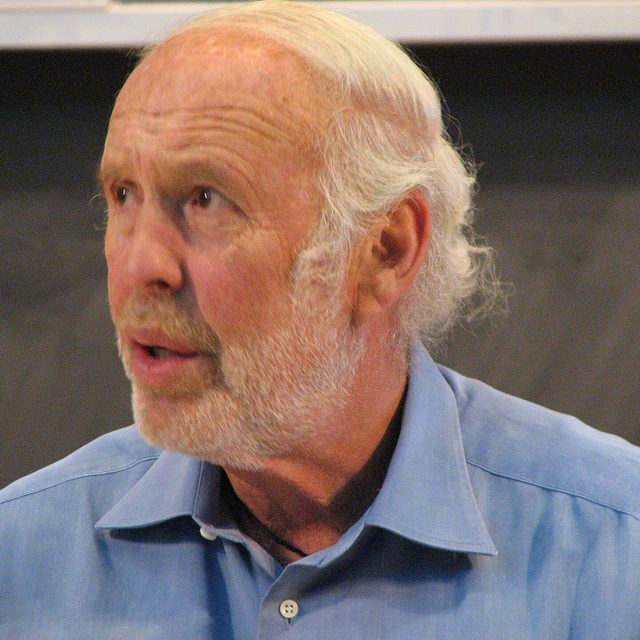
Renaissance began in 1978 as Monemetrics and was renamed in 1982. Its Medallion fund, established in 1988, is widely regarded as one of the most successful trading funds in history. It has been closed to outside investors since 1993 and is open only to current and former employees and their families; the firm bought out its last outside investor in 2005. The firm's funds for outside investors, including RIEF and RIDA, are far larger and have performed far less spectacularly.
Public references report that Medallion averaged about 66% a year before fees and about 39% after fees since 1988, with 98.2% in 2008 and 76% in 2020. Those are reported figures for a fund that outsiders cannot buy.
Simons retired as head in 2009, stayed on as chairman until 2021, and died in 2024. Peter Brown is CEO. In 2021, Simons, Robert Mercer and other executives agreed to pay up to $7 billion in taxes and penalties to settle a dispute over how Medallion's trades were structured, one of the largest settlements of its kind.
The firm's headline assets say little about Medallion's strength, because Medallion is kept deliberately small.
10 Point72 Asset Management

Point72 is the successor to S.A.C. Capital Advisors, which pleaded guilty to federal charges in 2013 after an insider-trading investigation. Cohen founded Point72 in 2014 as a family office, and it opened to outside investors in 2018 with about $3 billion from roughly 20 institutions. It runs discretionary long/short equity, systematic strategies (through Cubist Systematic Strategies), macro and venture capital, and employs more than 3,000 people.
Point72 trains many of its own portfolio managers through its LaunchPoint program; as of 2023, half of its long/short managers came from it. In January 2021 it and Citadel invested $2.75 billion in Melvin Capital after the GameStop short squeeze, and Point72 lost about $500 million on that investment in the first half of 2021. Cohen stepped down as president in April 2026, succeeded by Harry Schwefel, and remains chairman and CEO.
Point72 uses a partial pass-through expense structure, which sits between a traditional single-manager fund and the full pass-through of the biggest platforms.
11 Farallon Capital
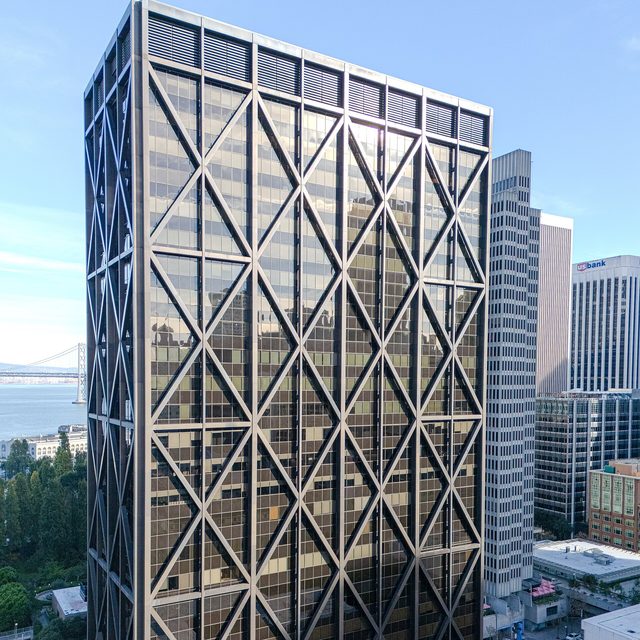
Tom Steyer started Farallon in January 1986 with $15 million in seed money. It invests in value opportunities, credit, merger arbitrage, real-estate-related assets and direct investments around the world, and it has long managed money for university endowments, foundations and wealthy families. Yale was an early investor.
Among its well-known deals, it bought control of Indonesia's Bank Central Asia for $531 million in 2002 and sold the stake for a profit in 2006, and it holds more than 6% of Toshiba. The firm has about 230 employees across offices including San Francisco, Tokyo, Singapore, London and Hong Kong.
Andrew Spokes was promoted when Steyer left the firm in 2012, and Nicolas Giauque became managing partner in 2025 when Spokes stepped down.
12 Davidson Kempner Capital Management

Founded in May 1983 as M.H. Davidson & Co., the firm opened to outside capital in 1987 and registered with the SEC in 1990. It uses a bottom-up, fundamental approach with an event-driven focus across credit, equity and real assets, including distressed situations. It had about 500 employees in 2023 and 13 managing members, with Anthony Yoseloff as chief investment officer.
It was ranked the eighth-largest hedge fund in the world as of 30 June 2022 in public references, and it has stayed in the $35 billion to $37 billion band since.
Davidson Kempner is a good example of a firm built on a patient, specialist skill (analysing corporate events and credit) rather than on a single trading model.
13 Viking Global Investors

Viking is one of the best-known "Tiger Cubs": Andreas Halvorsen trained at Julian Robertson's Tiger Management before founding the firm in October 1999. It focuses on fundamental long/short equity, and has also built long-only, private and credit strategies, with offices in New York, Hong Kong, London and San Francisco.
Viking has been willing to shrink. In June 2017 it returned $8 billion to investors to "reset to a smaller size," after assets had climbed. Public references later put its assets at about $59 billion in March 2021, and press reports said it reopened its flagship fund to new money in 2023.
Viking's 13F filings show US equity positions only. In February 2025, for example, the filings showed a new $526 million Boeing position and additions to General Motors, Bank of America, Charles Schwab and JPMorgan. They do not show its short positions.
14 GoldenTree Asset Management

GoldenTree calls itself a global credit manager. It invests in high-yield bonds, leveraged loans, distressed and structured credit and emerging-market debt, and in 2022 it added cryptocurrency investing. It has about 270 employees and counts public and corporate pension funds, endowments, foundations and sovereign wealth funds among its clients. It was named in Bloomberg's list of top-performing large hedge funds in 2013.
GoldenTree is a reminder that "hedge fund" covers more than stock-picking. A large share of hedge-fund assets sits in credit, which behaves very differently from equities.
15 Baupost Group

Baupost is run by Seth Klarman, the author of the investing classic Margin of Safety, and it is perhaps the purest value-investing shop on this list. It emphasises risk management and does not use leverage except in real estate. It buys distressed debt and other out-of-favour assets and opened a London office in 2011 to chase European opportunities. It employed about 61 people in 2020.
Public references cite average annual returns of about 20% since the firm's founding, but only about 4% a year from 2014 to 2024, a reminder that value strategies can have long dry spells.
If you want to understand the idea of a "margin of safety", the way Klarman applies it is one of the best examples. Our guide to margin of safety explains the concept in plain terms.
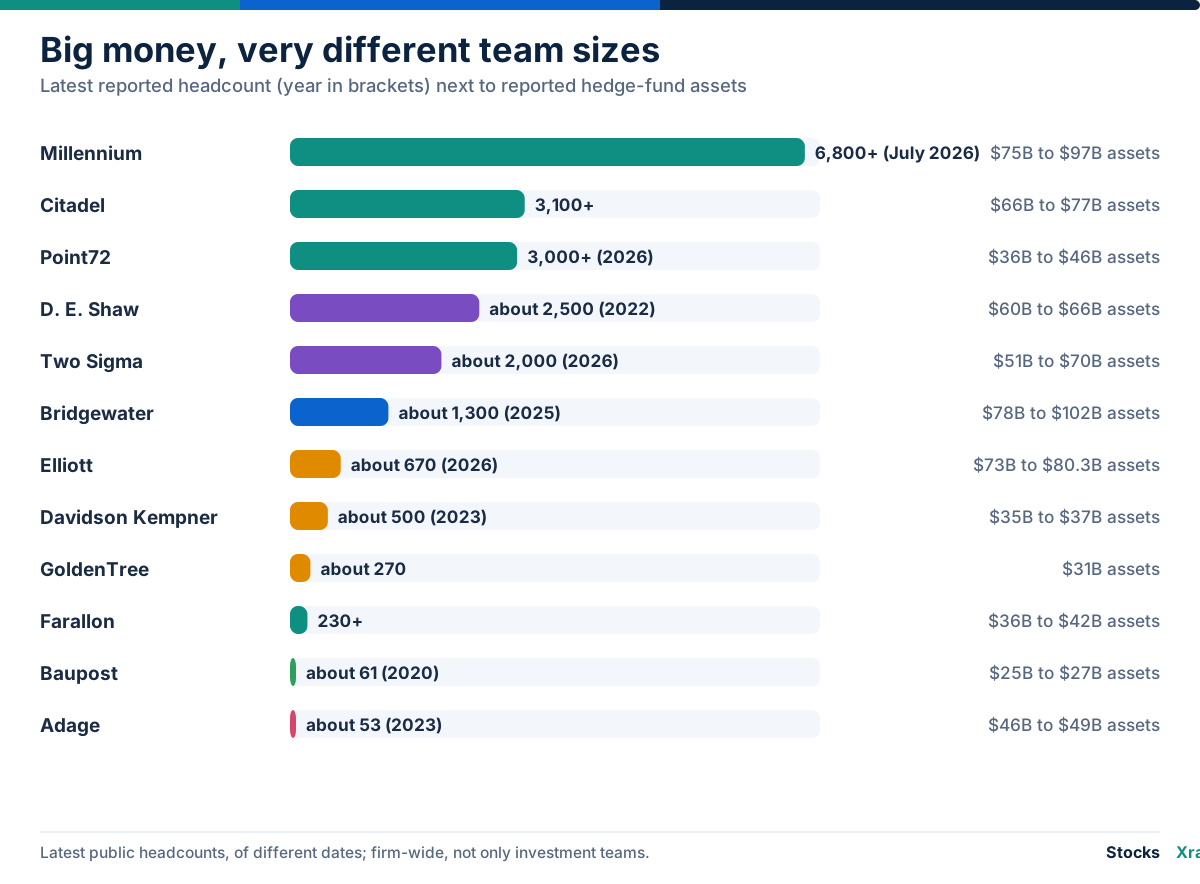
Team size: how many people run these funds
Assets under management say little about how a firm is built. Team size varies enormously across these fifteen, which is one more reason not to treat assets as a measure of quality.
What 13F filings can and cannot tell you
Many articles about hedge funds are really articles about 13F filings, so it is worth knowing exactly what these show.
What a 13F is. Institutional investment managers that exercise investment discretion over at least $100 million in certain US-listed securities must file Form 13F with the SEC every quarter, within 45 days of the quarter's end. The form lists their long positions in US-listed stocks and some related instruments such as options, warrants and ETFs.

What it leaves out.
- Short positions. A hedge fund that is short a stock does not report it. For long/short funds the 13F is half a picture.
- Non-US holdings. Positions in foreign markets are not included.
- Credit and private investments. Bonds, loans and private companies are mostly absent, which is why Elliott's 13F shows about $17.6 billion against about $80 billion in assets.
- Timing. A filing for the quarter ending 30 June can appear as late as mid-August. The fund may have sold the position by then.
- Leverage and hedges. A 13F shows what the fund owns, not how much it borrowed or what it hedged.
Is copying 13F holdings a strategy? It can be an interesting source of ideas, but it is a weak shortcut for returns. You see a delayed, partial snapshot, you do not know the fund's reasons or its exit plan, and the fund's results often depend on trades you cannot see.
The 2025 and 2026 backdrop
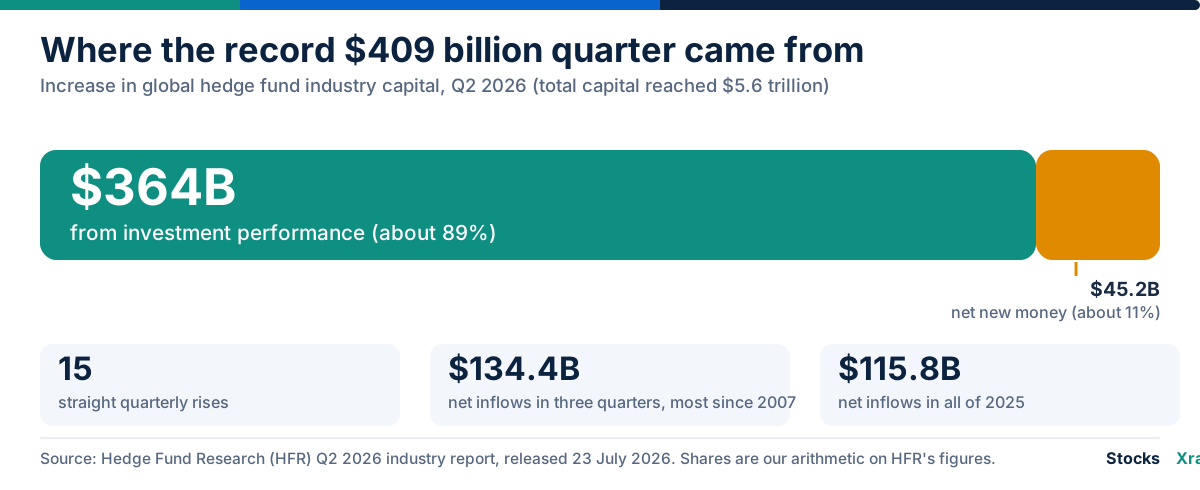
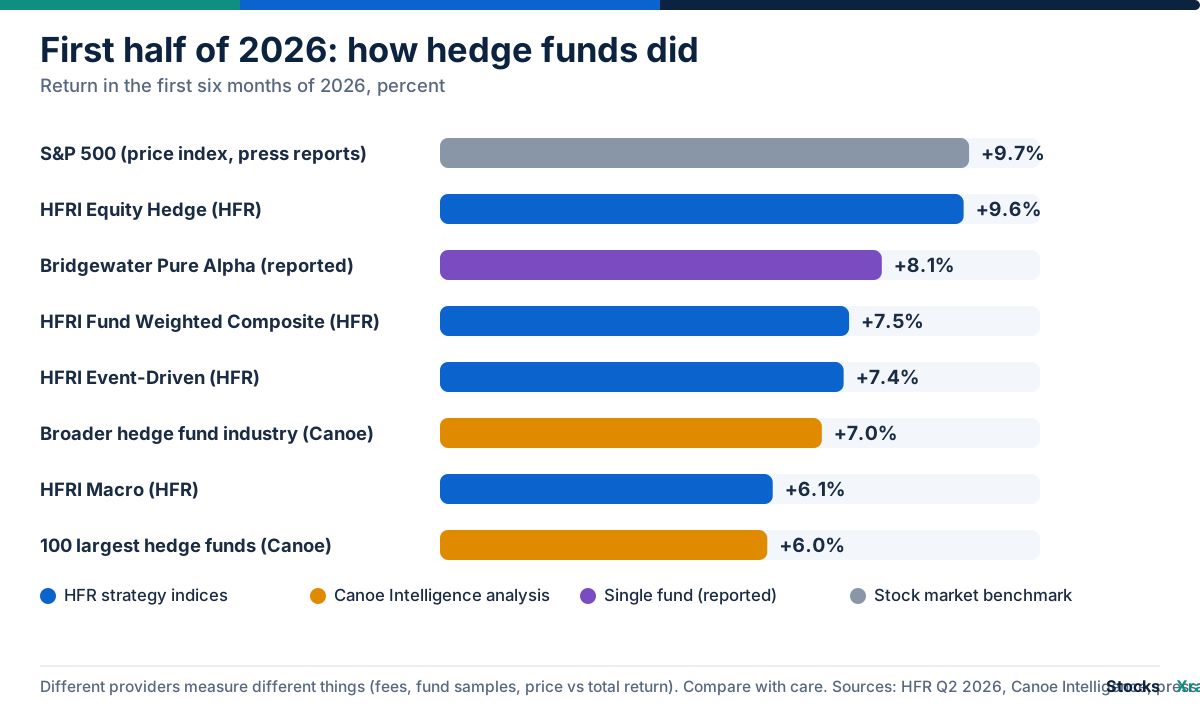
Hedge funds entered 2026 after strong years. HFR reported total industry capital of about $5.6 trillion at the end of the second quarter of 2026, up for the 15th quarter in a row, and a record $409.3 billion quarterly increase, of which an estimated $364 billion came from investment gains and $45.2 billion from new money. Its composite index of hedge fund performance rose about 7.5% in the first half of 2026, the strongest first half since 2021. Equity hedge funds led, with a gain of about 9.6%, followed by event-driven funds at 7.4% and macro funds at 6.1%. HFR linked the strength to enthusiasm for artificial intelligence and a busy market for new share listings, despite geopolitical tension.
The largest funds did not necessarily lead. A Canoe Intelligence analysis reported that the 100 largest hedge funds, which together hold about $3.2 trillion, returned about 6.0% in the first half of 2026, a percentage point behind the broader industry. Over the same period, press reports said Bridgewater's Pure Alpha, up about 8%, trailed the S&P 500.
One structural trend stands out: the multi-strategy platforms such as Millennium, Citadel, Point72 and Balyasny have been attracting more new assets than equity-focused funds. For investors, that means more money is going to a model that charges extra pass-through costs, and that places a heavy bet on the ability to hire and retain portfolio managers.
Can ordinary investors invest in hedge funds?
Not directly, in most cases. The funds above are restricted to institutions and accredited investors with large minimums. There are indirect routes, each with trade-offs.
- Liquid alternative funds. Mutual funds and ETFs that use some hedge-fund-style strategies, sometimes run by hedge-fund firms (AQR is one example). They are open to everyone and more liquid, but they are not the same as the private funds.
- Publicly traded managers. Some asset managers are listed on stock markets, so you can own the business rather than the fund.
- Your own portfolio. Many hedge-fund ideas, such as diversifying across asset types and controlling the size of losses, can be applied with ordinary funds. Our guides to diversification, ETFs and drawdowns and risk are a good start.
Why the "hedge fund" label deserves caution. Hedge funds are a mix of very different businesses, and the best-known track records belong to funds that are closed to new money. Fees, lock-ups and leverage are real costs. If a fund's returns are good, check whether they come after fees, over how many years, and with how large a worst fall.
Five lessons from the biggest hedge funds
- Process beats prediction. The firms at the top built repeatable processes: risk limits, research pipelines, data infrastructure. They do not rely on a single correct forecast.
- Capacity is a constraint. Renaissance keeps Medallion small, Bridgewater restricts Pure Alpha, Citadel returns profits, and Viking once handed back $8 billion. Some strategies stop working when they get too big.
- Leverage cuts both ways. Long-Term Capital Management in 1998 and the platform losses of 2008 show how borrowed money turns small mistakes into large ones.
- Costs matter. A fund that earns 10% before fees and 6% after has a very different value for investors. Pass-through expenses make comparison harder.
- Reported track records need context. Most returns are self-reported, often through anonymous sources, and survivors are more visible than failures.
Frequently asked questions
What is the biggest hedge fund in the US? It depends on the source. Bridgewater (Westport, Connecticut) and Millennium (New York) are usually the top two, with reported assets in the $90 billion to $100 billion range in 2026. Elliott and Citadel follow. Some rankings include firms with large non-hedge-fund businesses, which changes the order.
Which hedge fund has the best track record? Renaissance Technologies' Medallion fund has the best reported record by a wide margin, with about 39% a year after fees since 1988, but it is closed to outsiders. Among funds that have taken outside money more recently, Citadel has generated the largest cumulative gains for investors, reported at about $90 billion through 2025.
Can I invest in Bridgewater, Citadel or Millennium? Only if you are an institution or a qualified investor with a very large minimum, and often only if the fund is open to new money. For most people, the realistic options are liquid alternative funds, listed asset managers and sound portfolio construction.
Why do hedge fund rankings disagree? Because the funds are private and report on different dates, because some count only hedge-fund assets and others count the whole firm, and because leverage, returned profits and closed funds change the picture. Treat any single figure as an estimate.
What is a pod shop? A multi-strategy platform that hands capital to many independent teams ("pods"), each with strict risk limits, under central risk management. Millennium, Citadel, Point72, Balyasny and ExodusPoint are the best-known examples.
How much do hedge funds charge? Industry averages are now closer to a 1.3% management fee and a 16% performance fee than the old "2 and 20," but multi-strategy platforms often pass extra operating expenses through to investors, which can add several percentage points.
Are 13F filings useful? They are useful for seeing a fund's disclosed US stock positions with a delay, and they are free. They leave out shorts, non-US assets, credit and private investments, and they are at least 45 days old, so they are a starting point for research, not a signal to copy.
Do hedge funds beat the stock market? Some do over some periods, but not reliably. In the first half of 2026, for example, the largest 100 hedge funds returned about 6.0% according to one analysis while the S&P 500 rose by close to 10%, and results vary widely by fund and strategy.
How to follow the big money on StocksXray
You do not need a hedge fund account to follow what professional investors are doing. Several StocksXray tools use publicly available data.
- Commitments of Traders shows how large speculators and commercial hedgers are positioned in futures markets each week, including a "where each group sits against its own year" view. It is useful context for macro funds' favourite markets.
- Market Compass tracks the market regime, a risk gauge and sector outlook from prices and yields.
- Interest rates and country profiles give the macro backdrop that global macro funds react to.
- S&P 500 stocks ranked by X-Ray Score shows our five-lens score and fair value range for each large US company, so you can check a stock a famous fund owns against its fundamentals.
Data notes and disclaimer
Assets under management for private funds are estimates. We compiled figures from public rankings and compilations published in 2025 and 2026 (including With Intelligence data as of 30 June 2025, and 2026 lists from Financial Edge and Quantt), firms' own statements (for example Elliott's reported figure at 30 June 2026), regulatory filings referenced in public sources, and press reports of performance. Returns for private funds are usually unaudited, self-reported or sourced from people familiar with the firms, and they can change. Industry figures are from Hedge Fund Research's second-quarter 2026 report. Firm facts such as founding dates and leadership come from public references and were current when we checked, but they can change.
This article is for education only. It is not investment advice, and it does not recommend buying, selling or holding any security or fund. Hedge funds are complex, illiquid and risky, and are not suitable for most investors.
Related reading
Educational only, not financial advice. Examples use illustrative numbers.