OPEC Explained: Members, Quotas and How OPEC+ Moves Oil Prices
OPEC, the Organization of the Petroleum Exporting Countries, is a Vienna-based group of oil-exporting governments founded in 1960 to coordinate petroleum policy. Since 2016 it has cooperated with non-OPEC producers, ten of them today and led by Russia, in a looser alliance called OPEC+. As of October 2026 OPEC has 11 active members after the United Arab Emirates announced its exit. This guide explains who is in each group, how quotas and meetings work, how much oil they control, and what the record shows about their effect on prices.
Key takeaways
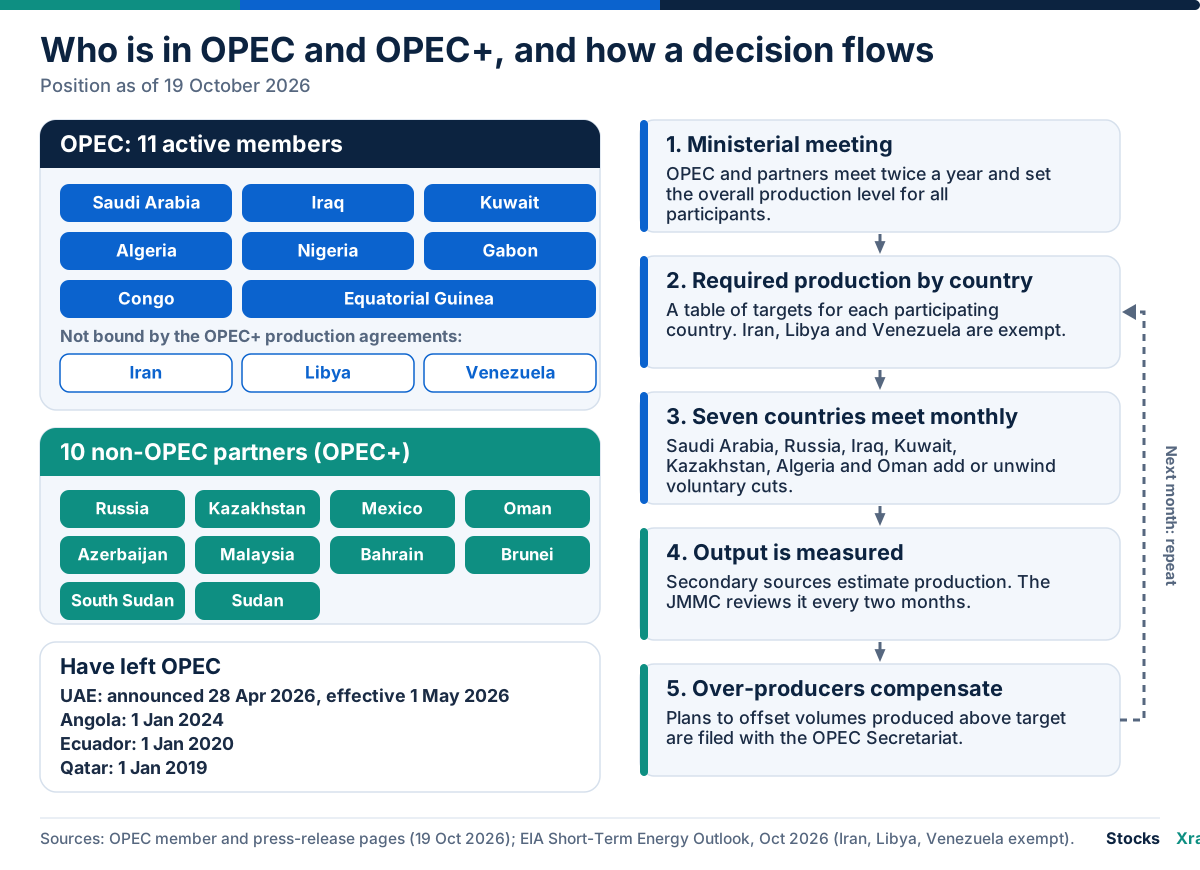
- OPEC has 11 active members as of October 2026. The UAE announced on 28 April 2026 that it was leaving OPEC and OPEC+ from 1 May, although OPEC's own member page still listed 12 countries when we checked on 19 October.
- OPEC+ is OPEC plus ten non-OPEC producers under the Declaration of Cooperation of 10 December 2016. It is voluntary: targets are set by consensus and checked against outside estimates of output.
- In 2025 the 11 current members produced 31% of world crude oil and the countries actually bound by OPEC+ targets about 42%, according to the US Energy Information Administration (EIA). The United States alone produced 17%.
- Announced cuts often move prices on the day but not for long. Brent spot rose 8.4% after the surprise cut of 2 April 2023 and was below its starting level by 31 May.
- Since 28 February 2026 the dominant force has been the disruption around the Strait of Hormuz, not quotas. Brent spot peaked at $138.21 on 7 April 2026 and averaged $114 in September (EIA).
What OPEC is, and what it is not
OPEC was created at a conference in Baghdad on 10 to 14 September 1960 by Iran, Iraq, Kuwait, Saudi Arabia and Venezuela. Its secretariat sat in Geneva for five years and moved to Vienna on 1 September 1965. Its Statute sets the mission: coordinate and unify members' petroleum policies, stabilize the oil market, and balance an efficient and regular supply for consumers, a steady income for producers and a fair return for investors.
Inside OPEC itself, the Conference of member delegations is the supreme authority. It meets twice a year and each full member has one vote. Apart from procedural matters, every decision needs the agreement of all full members, and three-quarters of members must attend for a meeting to be valid. A new full member must be accepted by three-quarters of the existing full members, including all five founders.
Cartel in law and in common usage
In economic usage, a cartel is a group of producers that coordinates output to support the price of what they sell, and OPEC is the textbook example. Legally, OPEC is an intergovernmental organization of sovereign states, not a company. In 1981 a US federal appeals court upheld the dismissal of an antitrust suit against it on act-of-state grounds, and Congress has debated bills since 2000, known as NOPEC, to remove that obstacle.
Economists disagree about how tightly OPEC behaves like a cartel. A widely cited 2005 study in The Energy Journal found evidence of cooperation among members but noted that standard tests have little power to separate collusion from competition. Do not confuse OPEC with OAPEC, the Organization of Arab Petroleum Exporting Countries, a separate body that imposed the 1973 to 1974 embargo on the United States, according to the Federal Reserve's history of the episode.
Who is in OPEC in October 2026
OPEC's own member page showed 12 members when we checked it on 19 October 2026. Our count is 11. The UAE announced on 28 April 2026 that it would leave OPEC and OPEC+ with effect from 1 May, and since then OPEC's meeting statements no longer list it, while the EIA and the International Energy Agency (IEA) count it as outside the group.
| Country | Joined | Notes |
|---|---|---|
| Saudi Arabia | 1960 | Founder member |
| Iran | 1960 | Founder member; not bound by OPEC+ targets |
| Iraq | 1960 | Founder member |
| Kuwait | 1960 | Founder member |
| Venezuela | 1960 | Founder member; not bound by OPEC+ targets |
| Libya | 1962 | Not bound by OPEC+ targets |
| Algeria | 1969 | |
| Nigeria | 1971 | |
| Gabon | 1975 | Left in January 1995, rejoined July 2016 |
| Equatorial Guinea | 2017 | |
| Congo (Republic of the Congo) | 2018 | |
| United Arab Emirates | 1967 | Announced exit 28 April 2026, effective 1 May 2026; still listed on OPEC's member page |
Who has left, and who has joined since 2016
| Country | Membership record | Exit |
|---|---|---|
| Indonesia | Joined 1962; suspended January 2009; reactivated January 2016 | Suspended again on 30 November 2016 (not counted as a member) |
| Qatar | Joined 1961 | Left on 1 January 2019 |
| Ecuador | Joined 1973; suspended December 1992; rejoined October 2007 | Left effective 1 January 2020 |
| Angola | Joined 2007 | Left effective 1 January 2024 |
| United Arab Emirates | Joined 1967 (as Abu Dhabi) | Announced 28 April 2026, effective 1 May 2026 |
Since 2016 three countries have joined or returned: Gabon (July 2016), Equatorial Guinea (2017) and Congo (2018).
The UAE's statement, carried by its state news agency, cited a review of its production policy and capacity, its national interest and a long-term strategy that includes more domestic investment. It produced about 3.4 million barrels per day (mb/d) of crude in 2025 against effective capacity that EIA estimates at 4.2 mb/d, the third largest in the group after Saudi Arabia and Iraq. The Associated Press reported no immediate public reaction from Saudi Arabia or OPEC, and quoted the UAE energy minister saying the decision did not stem from a dispute with Saudi Arabia.
Two points need care. First, OPEC's Statute says a withdrawal takes effect at the start of the next calendar year after notice is received. The exits of Qatar, Ecuador and Angola all took effect on 1 January, while the UAE announced 1 May. We found no OPEC statement explaining how the two fit together, which may be why the membership page has not changed. Second, the practical record is clear: from its 3 May 2026 meeting onward OPEC's statements name seven countries in the voluntary-cut group instead of eight, its monitoring committee no longer lists the UAE, and EIA's October 2026 data count OPEC as the 11 countries above.
OPEC+ and the Declaration of Cooperation
OPEC+ is the informal name for OPEC plus the non-OPEC producers that take part in the Declaration of Cooperation (DoC). The DoC grew out of the price slide that began in 2014: at its 27 November 2014 meeting the OPEC Conference kept its 30.0 mb/d ceiling, noting that non-OPEC supply was expected to grow by 1.36 mb/d in 2015. EIA describes the group's later formation as a response to falling prices driven largely by US shale growth.
On 30 November 2016 OPEC agreed a new target of 32.5 mb/d, a cut of 1.2 mb/d, from 1 January 2017. On 10 December 2016 eleven non-OPEC producers joined, pledging a combined reduction of 558,000 barrels per day, and two of them took seats on the ministerial monitoring committee. One of the eleven, Equatorial Guinea, has since become an OPEC member. Ten partners remain.
| Partner | Crude oil production in 2025 (mb/d) |
|---|---|
| Russia | 9.12 |
| Kazakhstan | 1.75 |
| Mexico | 1.43 |
| Oman | 0.77 |
| Azerbaijan | 0.46 |
| Malaysia | 0.37 |
| Bahrain | 0.18 |
| South Sudan | 0.11 |
| Brunei | 0.09 |
| Sudan | 0.03 |
In 2019 the group added the Charter of Cooperation, signed on 2 July 2019, a broader forum for dialogue on technology, climate change and future energy pathways. Brazil joined the Charter, but not the production agreements, in February 2025.
The DoC is a voluntary framework, not a treaty or a company. Today it has three layers: an overall production level for all participants, extended in December 2024 to 31 December 2026 and reaffirmed on 7 June 2026; extra voluntary cuts by a subgroup, eight countries until April 2026 and seven since; and exemptions, since EIA's tables treat Iran, Libya and Venezuela as not subject to the agreements.
How decisions are made
The meetings
| Body | Who sits on it | How often | Next date |
|---|---|---|---|
| OPEC Conference | OPEC members only | Twice a year (Statute) | Not announced in the sources we checked |
| Ministerial Meeting (ONOMM) | OPEC and the ten partners | Every six months; the 41st was on 7 June 2026 | 29 November 2026 (42nd) |
| Joint Ministerial Monitoring Committee (JMMC) | Saudi Arabia, Russia, Iraq, Kuwait, Kazakhstan, Nigeria, Algeria, Venezuela | Every two months; can call extra meetings | 29 November 2026 (69th) |
| Voluntary-cut group | Saudi Arabia, Russia, Iraq, Kuwait, Kazakhstan, Algeria, Oman | Monthly, on the first Sunday of the month in 2026 | 1 November 2026 |
Dates in the table are those published by OPEC when we checked on 19 October 2026, and OPEC can reschedule them.
Required production, consensus and baselines
Each participant has a "required production" level for each month, published in a table with the monthly statements. Levels start from a baseline: for the April 2020 cuts it was each country's October 2018 output, with Saudi Arabia and Russia both set at 11.0 mb/d. On 7 June 2026 the ministers said a capacity assessment would be the reference for 2027 baselines.
OPEC's statements describe decisions as agreed by the participating countries and call consensus essential to the group's cohesion. They do not report votes. Inside OPEC proper, as noted above, the Statute requires unanimity for most Conference decisions.
Compliance and its limits
OPEC measures output with outside estimates, not self-reports: its 2024 statements specify the average of seven approved secondary sources. In March 2022 the Conference swapped the IEA for Wood Mackenzie and Rystad Energy among the sources used to assess members' output. A country that produces above its required level files a plan to produce below target later.
The limits show in OPEC's own statements. Iraq and Kazakhstan produced above their levels from January 2024, and in September 2024 the eight countries said both had recommitted to full conformity and compensation schedules. The compensation period has been extended more than once, most recently to the end of December 2026.
Worked example (illustrative, round numbers, not any country's figures). A producer's required production for a month is 3,000 thousand barrels per day (kb/d) and it actually pumps 3,090 kb/d. It overproduced by 90 kb/d. Over a 30-day month that is 90,000 barrels a day times 30, or 2.7 million barrels. If it agrees to offset the overage over the next nine months (270 days), it must produce 2.7 million divided by 270, or 10,000 barrels a day, below target: 2,990 kb/d.
For scale, using real numbers: the 188 kb/d monthly step adopted by the seven countries for June to September 2026 equals 0.18% of the 104.4 mb/d the world consumed in 2025 (EIA).
Spare capacity: the cushion
Spare capacity, also called surplus capacity, is production that could be brought online quickly and sustained, but is being held back. EIA defines it as output that can be added within 30 days and sustained for at least 90 days. In its Short-Term Energy Outlook, EIA measures it as effective capacity minus actual production, and counts production shut in by wars or outages as a disruption, not as spare capacity.
It matters because it is the market's buffer: when spare capacity is large, a supply loss can be covered and prices carry a smaller risk premium. EIA says OPEC members hold almost all of the world's spare capacity, with Saudi Arabia historically holding the most. A 2024 EIA note named the UAE as the only other member with notable amounts.
EIA estimates that spare capacity of the 11 current members averaged 3.43 mb/d in 2025, falling from 3.91 mb/d in the first quarter to 3.02 mb/d in the fourth. It puts the figure at 0.02 mb/d in both the second and third quarters of 2026, because capacity shut in by the disruption does not count as spare. For 2025 EIA put Saudi effective capacity at 11.6 mb/d against 9.3 mb/d produced, and the UAE at 4.2 mb/d against 3.4 mb/d.
The major decisions, 2020 to 2026
The table gives each decision as OPEC stated it. Sizes are changes to required production or voluntary targets, not necessarily to actual output.
| Date | Meeting or group | Decision |
|---|---|---|
| 12 Apr 2020 | 10th (Extraordinary) Ministerial Meeting | Cut overall output by 9.7 mb/d from 1 May 2020; 7.7 mb/d from July to December 2020; 5.8 mb/d from January 2021 to April 2022 |
| 3 Dec 2020 | 12th Ministerial Meeting | From January 2021 the cut eases by 0.5 mb/d (7.7 to 7.2 mb/d); monthly ministerial meetings begin |
| 18 Jul 2021 | 19th Ministerial Meeting | Raise output by 0.4 mb/d a month from August 2021 to phase out the 5.8 mb/d cut; agreement extended to end-2022 |
| 2 Jun 2022 | 29th Ministerial Meeting | July and August increases each set at 0.648 mb/d instead of 0.432 mb/d, pulling September's increase forward |
| 5 Oct 2022 | 33rd Ministerial Meeting | Cut targets by 2.0 mb/d from August 2022 levels, starting November 2022; agreement extended to end-2023 |
| 2 Apr 2023 | Nine countries (noted by the JMMC on 3 April) | Voluntary cuts totaling 1.66 mb/d from May to end-2023: Saudi Arabia 500 kb/d, Iraq 211, UAE 144, Kuwait 128, Kazakhstan 78, Algeria 48, Oman 40, Gabon 8, Russia 500 |
| 4 Jun 2023 | 35th Ministerial Meeting | Overall level of 40.46 mb/d for 2024, split by country |
| 30 Nov 2023 | 36th Ministerial Meeting and announcement | Extra voluntary cuts of 2.2 mb/d for the first quarter of 2024: Saudi Arabia 1,000 kb/d, Iraq 223, UAE 163, Kuwait 135, Kazakhstan 82, Algeria 51, Oman 42, Russia 500 |
| 2 Jun 2024 | Eight countries, Riyadh | Extend the 1.65 mb/d to end-2025; extend the 2.2 mb/d to end-September 2024, then phase it out monthly |
| 5 Dec 2024 | 38th Ministerial Meeting and eight countries | Extend overall levels to 31 December 2026; extend the 1.65 mb/d to end-2026; phase out the 2.2 mb/d from April 2025 |
| Apr to Aug 2025 | Eight countries, monthly | Return the 2.2 mb/d faster than planned: +411 kb/d for each of May, June and July, +548 for August, +547 for September |
| Sep to Nov 2025 | Eight countries, monthly | Begin returning the 1.65 mb/d at 137 kb/d a month for October, November and December; pause January to March 2026 |
| 1 Mar and 5 Apr 2026 | Eight countries | Resume with +206 kb/d for April and +206 kb/d for May |
| 28 Apr 2026 | UAE | Announces exit from OPEC and OPEC+ effective 1 May |
| May to Aug 2026 | Seven countries, monthly | +188 kb/d a month for June, July, August and September |
| 7 Jun 2026 | 41st Ministerial Meeting | Reaffirm overall levels to 31 December 2026; capacity assessment to set 2027 baselines |
| 6 Sep and 4 Oct 2026 | Seven countries | Keep September 2026 required production for October and November |
How much of the market OPEC controls
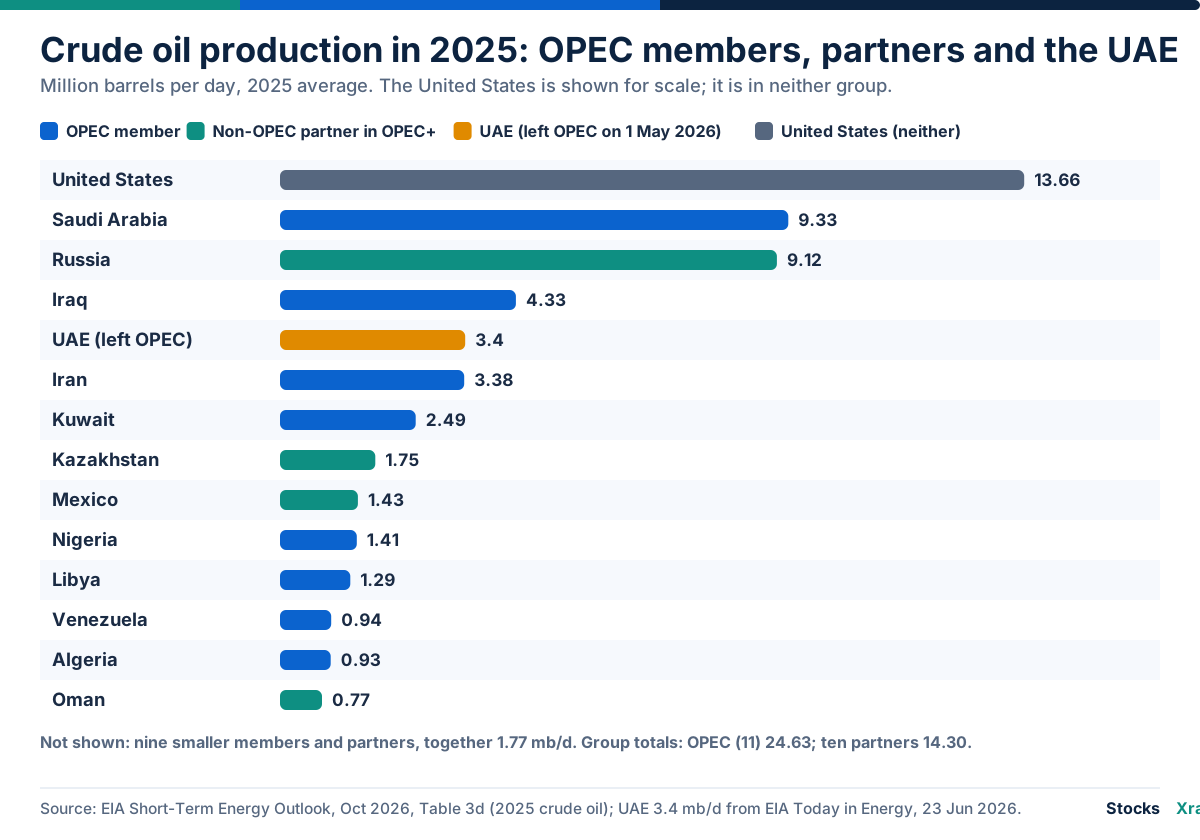
EIA's October 2026 data put world crude oil production at 79.0 mb/d in 2025. The 11 current OPEC members produced 24.63 mb/d, or 31%. EIA's own "OPEC+" figure counts only countries bound by the agreements, which leaves out Iran, Libya and Venezuela, and comes to 33.33 mb/d, about 42%. Adding all 11 members and the ten partners gives 38.93 mb/d, about 49%. Of the 24.63 mb/d, 19.03 mb/d came from members bound by the agreements and 5.61 mb/d from the three exempt ones. The ten partners produced 14.30 mb/d, the United States 13.66 mb/d and all other producers 26.40 mb/d.
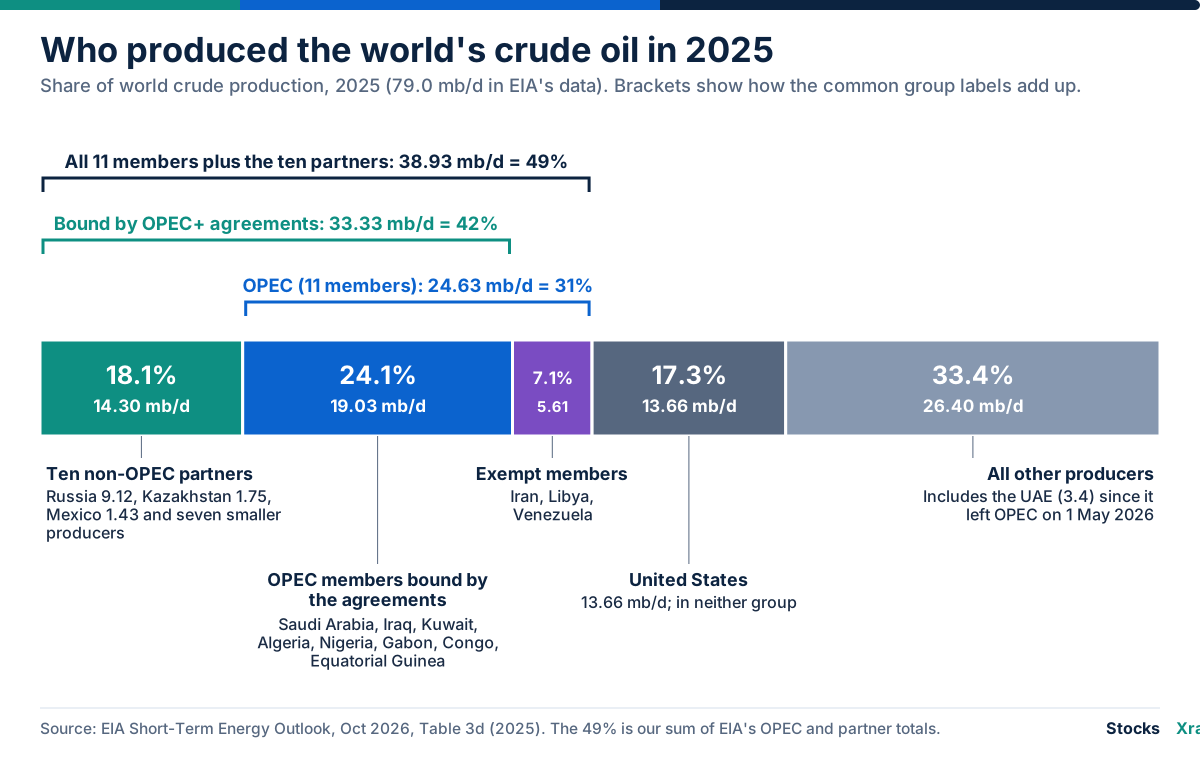
With the UAE counted, EIA put OPEC at 28.0 mb/d and 35% of world crude in 2025, and OPEC+ at about 46%. Among members, Saudi Arabia produced 9.33 mb/d, Iraq 4.33, Iran 3.38, Kuwait 2.49 and Nigeria 1.41. Definitions differ by source: OPEC's own Annual Statistical Bulletin gives world crude production of 74.85 mb/d for 2025.
Market share is only part of pricing power. The other parts are spare capacity, covered above, and the "call on OPEC", which EIA defines as how much crude the world needs from OPEC once non-OPEC supply is counted: the higher it is, the more influence OPEC has on prices.
Non-OPEC supply is the counterweight. EIA describes most non-OPEC producers as price takers that produce at or near full capacity, with investment that responds more readily to market signals. The United States is the largest producer: 13.66 mb/d of crude in 2025, about 17% of the world total, ahead of Saudi Arabia in second place. For the wider US economy, see our United States country profile.
How OPEC decisions have moved oil prices
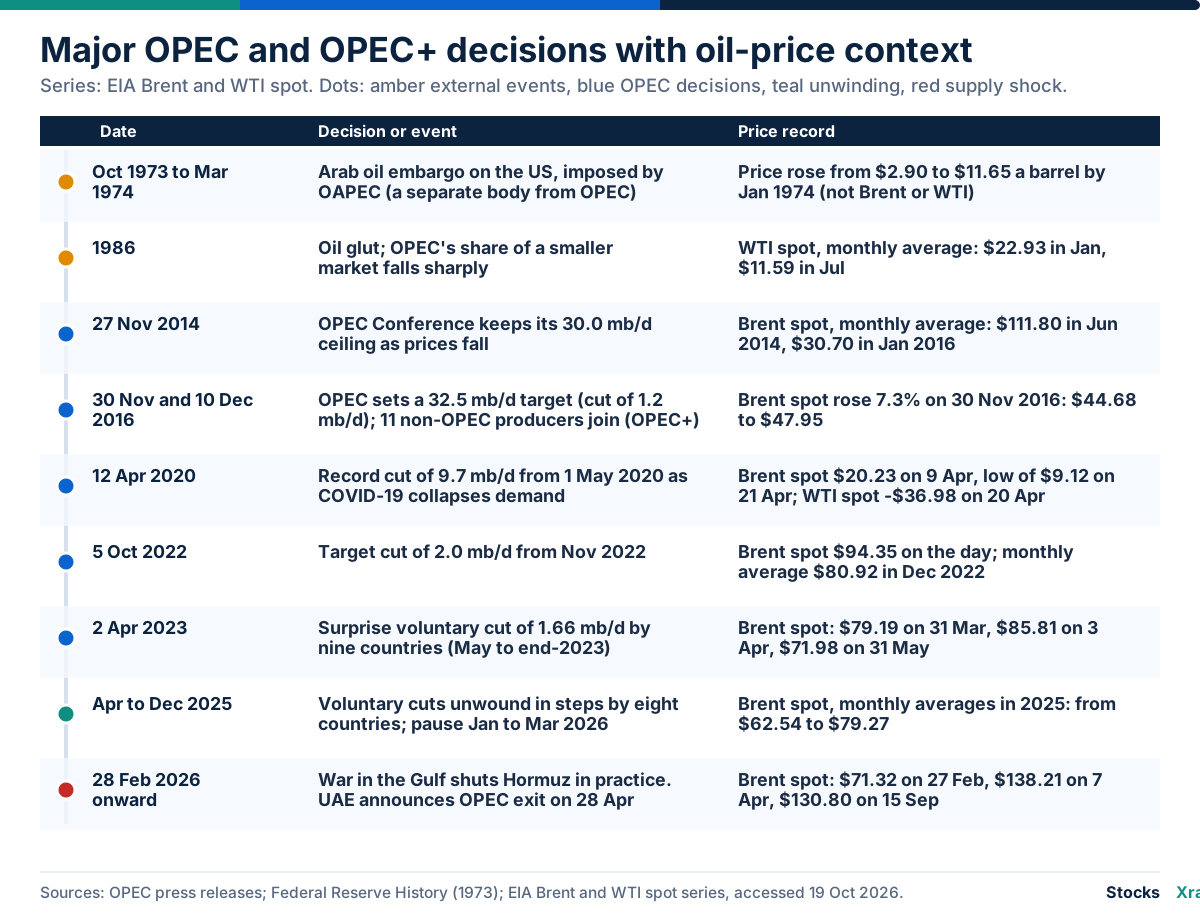
The pattern is consistent. The deepest price falls, in 1986, from 2014 to 2016 and in 2020, came when weak demand or rising supply from outside the group overwhelmed the market. OPEC's own history cites a glut in 1986, and in 2014 its Conference pointed to growing non-OPEC supply. The sharpest rises, in 1973 to 1974, in 2022 and in 2026, came with supply shocks and war. Price series differ by row: the 1973 figures are a published crude price, not Brent or WTI, and the 1986 row uses WTI spot.
Other numbers in the graphic: the price was $2.90 a barrel before the 1973 embargo and $11.65 by January 1974. WTI spot fell from a monthly average of $22.93 in January 1986 to $11.59 in July. Brent spot was $94.35 on 5 October 2022, the day of the 2.0 mb/d cut, and averaged $80.92 in December 2022. Through 2025, as the group unwound its voluntary cuts, monthly Brent averages ranged from $62.54 to $79.27.
Announcements, expectations and actual supply
Prices react to what traders expect, and an announcement changes expectations at once. After the 5 October 2022 decision, EIA reported that front-month Brent futures rose $6.46 a barrel between 30 September and 6 October, mostly on expectations of cuts. Yet EIA's production forecast barely changed, because it had already assumed members would fall short of their earlier targets. A cut of 2.0 mb/d on paper removes far fewer barrels when the group as a whole is already producing below its limits.
The surprise cut of 2 April 2023 shows how quickly an effect can fade. Brent spot rose 8.4% on the first trading day, from $79.19 to $85.81. By 31 May it was $71.98, below where it started and 16% below its post-announcement level. EIA's May 2023 outlook said the cut raised prices on expectations of tighter supply, but that worries about the economy, the banking sector and inflation outweighed the initial rise.
Expectations work the other way too. In November 2014 OPEC chose not to cut while noting that non-OPEC supply was set to grow, and Brent spot averaged $111.80 in June 2014, $62.34 in December 2014 and $30.70 in January 2016. When OPEC agreed its 2016 target, Brent spot rose 7.3% on 30 November 2016, from $44.68 to $47.95.
Demand, and the cut that did not stop a collapse
OPEC+ agreed a cut of 9.7 mb/d on 12 April 2020, which OPEC describes as the largest voluntary production adjustment in the oil market's history. OPEC describes the setting as demand in freefall and storage filling fast. Brent spot was $20.23 on 9 April and still fell to $9.12 on 21 April, and EIA's WTI spot series recorded -$36.98 on 20 April. Monthly average Brent spot was $18.38 in April, $29.38 in May and $40.27 in June, as lockdowns eased and supply fell. OPEC's June 2020 statement credited the cuts together with reopening economies. Supply and demand moved together, so the cut's own effect cannot be isolated.
Inventories and the dollar
EIA describes inventories as the balancing point between supply and demand, and as a physical buffer. A sharp loss of current supply can push current prices above future prices, which encourages stock draws to meet immediate demand. EIA estimates that global inventories fell by an average of 1.9 mb/d in the third quarter of 2026, and the IEA put observed global stocks 509 million barrels below pre-war levels at the end of September.
Oil is priced mainly in US dollars. EIA notes that over several decades a weaker dollar has tended to coincide with higher oil prices and the reverse, though the relationship is complex and the shale boom has sometimes broken it. Our currency strength page shows how the dollar has moved against other majors.
When physical supply is the constraint: 2026
A war involving Iran began on 28 February 2026 and, according to EIA, effectively closed the Strait of Hormuz to shipping. In 2024 about 20 mb/d of oil moved through the strait, roughly a fifth of world liquids consumption. EIA estimates flows fell from 21.6 mb/d in the fourth quarter of 2025 to 4.9 mb/d in the second quarter of 2026. Its October 2026 outlook puts crude production shut in across the region at a peak of 10.9 mb/d in May, 5.8 mb/d in August and 4.8 mb/d in September.
Brent spot moved from $71.32 on 27 February to $138.21 on 7 April, with monthly averages of $103.13 in March, $117.29 in April, $85.40 in June and $114.16 in September. In mid-September attacks on Saudi Arabia's East-West pipeline, a bypass that had been carrying more than 5.0 mb/d to the Red Sea, pushed the daily price to $130.80 on 15 September.
In that setting quotas were not the binding limit. The IEA put Saudi crude supply at 8.3 mb/d in September, 2.18 mb/d below its implied target, and EIA wrote that the strait's effective closure limited the group's ability to raise output even as it kept setting targets. OPEC's own statements turned to shipping: on 12 October 2026 ministers said shipping and insurance costs had risen to more than a third of the value of the commodity.
Live charts
Our pages use fund proxies rather than futures prices. The Brent oil page tracks the United States Brent Oil Fund (BNO) and the WTI crude oil page tracks the United States Oil Fund (USO). The funds hold futures and bear roll costs, so their percent changes follow but do not equal spot changes.
As of 16 Oct 2026, the Brent proxy shows a one-month change of +10.3% and a one-year change of +137.8%. The WTI proxy shows +4.2% over one month and +134.5% over one year. The crude oil forecast page shows probability ranges built from past price moves, which are ranges and not targets, and the crude oil positioning page shows how large speculators and hedgers are placed in WTI futures each week, from CFTC data.
What to watch
The OPEC+ calendar is knowable in advance. The voluntary-cut group (eight countries, then seven) met on the first Sunday of every month from January to October 2026, the monitoring committee meets every two months and the ministers twice a year. The surprises come from what is decided, or from an unscheduled meeting.
Publication dates below are as announced on 19 October 2026 and can change.
| Source | Publisher | Timing | What it shows |
|---|---|---|---|
| Monthly meeting statement | OPEC | First Sunday; next 1 November 2026 | Next month's required production for the seven countries |
| Ministerial and JMMC meetings | OPEC | 29 November 2026 | Compliance, compensation and the 2027 baselines |
| Monthly Oil Market Report | OPEC | 11 November and 14 December 2026 | OPEC's view of demand, supply and stocks |
| Short-Term Energy Outlook | EIA | 10 November 2026 | Production, shut-ins and spare-capacity estimates |
| Weekly Petroleum Status Report | EIA | Weekly, normally Wednesday | US crude and product inventories |
| Oil Market Report | IEA | Monthly | Global stocks and flows |
| Commitments of Traders | CFTC | Weekly | Trader positioning in WTI futures |
Currencies and inflation
Oil feeds currencies through export income. Canada is a net oil exporter, and the Bank of Canada has said the Canadian dollar tends to move with the oil price, although a 2017 staff note found oil explained only a small part of its 2014 to 2015 fall. Norges Bank research finds the krone's link to oil is real but unstable, and stronger when oil moves are bigger than average. Russia is the third case people cite, but the mandatory sale of exporters' foreign-currency earnings, introduced in 2022, complicates how the ruble reacts to oil.
For Canada the pair to watch is USD/CAD, where a stronger Canadian dollar shows up as a lower pair, all else equal. Interest-rate gaps and risk appetite often matter more over short periods.
For inflation, fuel prices flow into headline consumer prices, and OPEC's 12 October 2026 statement itself pointed to added inflationary pressure from shipping and insurance costs. Central banks watch whether an energy shock spreads into wages and core prices, as covered in our posts on inflation and stocks and on interest rates and the Fed.
For companies, see our energy sector guide, cyclical stocks and normalized earnings, and futures contracts basics for the instruments behind benchmark prices.
Common mistakes
- Using an old member list. Qatar left in 2019, Ecuador in 2020, Angola in 2024 and the UAE announced its exit in 2026. A list of 13 members predates Angola's exit; a list of 12 predates the UAE's exit or uses OPEC's formal count.
- Treating OPEC and OPEC+ as one body. OPEC has members. OPEC+ adds ten partners under a voluntary agreement, and Russia, Mexico and Kazakhstan are partners, not members.
- Reading a headline cut as barrels removed. A cut from a target is not a cut from output, as October 2022 showed.
- Assuming OPEC sets the price. OPEC adjusts supply targets. Benchmark prices are set by trading, where demand, stocks, the dollar and war all weigh in.
- Judging a decision by one day. The April 2023 jump was gone by the end of May.
Frequently asked questions
What is OPEC? OPEC is the Organization of the Petroleum Exporting Countries, an intergovernmental organization founded in Baghdad in September 1960 and based in Vienna since 1965. Its Statute commits members to coordinate petroleum policies and help stabilize the oil market.
Which countries are OPEC members in 2026? The 11 active members are Saudi Arabia, Iran, Iraq, Kuwait, Venezuela, Libya, Algeria, Nigeria, Gabon, Equatorial Guinea and Congo. The UAE announced on 28 April 2026 that it was leaving effective 1 May, although OPEC's own member page still listed it as the twelfth when we checked on 19 October 2026.
What does OPEC+ mean? OPEC+ is the informal name for OPEC and ten non-OPEC producers that cooperate under the Declaration of Cooperation signed on 10 December 2016. The partners are Russia, Kazakhstan, Mexico, Oman, Azerbaijan, Malaysia, Bahrain, Brunei, South Sudan and Sudan. The difference from OPEC is that OPEC is a permanent organization with a Statute and 11 members, while OPEC+ is a voluntary agreement that adds the partners.
Is Russia a member of OPEC? No. Russia is the largest non-OPEC partner in OPEC+, producing about 9.12 mb/d of crude in 2025 according to EIA. It sits on the monitoring committee and co-chaired the first joint ministerial meeting in December 2016, but it is not a member of OPEC itself.
Does OPEC set the price of oil? No. Benchmark prices such as Brent and WTI are set by trading. OPEC and its partners influence supply, and so expectations about supply, but demand, inventories, the dollar and events such as the 2026 Hormuz disruption can outweigh their decisions.
What is a production quota? A quota is a target for how much oil a country may produce in a month. OPEC calls it "required production". Output is checked against outside estimates, and a country that overproduces files a plan to compensate later.
Who has the most spare capacity? Saudi Arabia has historically held the most, according to EIA, which put its effective capacity at 11.6 mb/d against 9.3 mb/d of production in 2025. In the second and third quarters of 2026 EIA put OPEC's spare capacity near zero, because production shut in by the Hormuz disruption counts as an outage.
Why did the UAE leave OPEC? The UAE said the decision followed a review of its production policy and capacity and rested on its national interest and long-term strategy. Some analysts have linked the move to production limits: it produced about 3.4 mb/d in 2025 against effective capacity that EIA estimates at 4.2 mb/d.
Sources and data notes
- OPEC: member countries, Statute, brief history, Declaration and Charter of Cooperation pages, and press releases for 2014 to 2026.
- EIA, Short-Term Energy Outlook, October 2026, and the archived October and November 2022, May 2023 and May 2026 editions.
- EIA, Today in Energy: UAE's exit from OPEC+ (23 June 2026) and OPEC capacity definitions; EIA, What drives crude oil prices.
- EIA spot price series: Brent and WTI.
- IEA, Oil Market Report, October 2026.
- Federal Reserve History, Oil Shock of 1973 to 74.
- Associated Press report on the UAE announcement, 28 April 2026; Bank of Canada (2015 statement, 2017 staff note), Norges Bank (2016 staff memo) and Bank of Russia (2022 press release) on currencies.
This guide covers membership, decisions and prices through 19 October 2026. It does not include forecasts, OPEC's own share-of-production table or its October 2026 Monthly Oil Market Report, which we could not access.
Educational information, not financial advice.
Related reading
Educational only, not financial advice. Examples use illustrative numbers.