What Is a Hedge Fund? How They Work, Fees, Strategies, Who Can Invest

A hedge fund is a private investment fund that pools money from institutions and wealthy individuals and can use tools that mutual funds mostly cannot, such as short selling, borrowing and derivatives. A professional manager runs it and is paid a fee on the assets plus a share of the profits. In the United States only qualified investors may buy in. This guide explains how hedge funds work, what they cost, how they differ from other funds, what the evidence says about returns, and what ordinary investors can do instead.
Key takeaways
- A hedge fund is defined by how it is built and paid, not by hedging. US law has no formal definition. For reporting, the SEC treats a private fund as a hedge fund if it can charge performance fees on unrealized gains, borrow heavily or sell short.
- Access depends on wealth tests. Investors must usually be accredited (income above $200,000, or $300,000 jointly, or net worth above $1 million excluding the home). Larger funds often require qualified purchasers, with at least $5 million in investments.
- Fees are lower than the old "2 and 20" but still high. HFR put the industry averages at a 1.32% management fee and a 15.74% performance fee in the second quarter of 2026.
- Returns are mixed. The HFRI hedge fund index gained about 12.5% in 2025 against about 17.8% for the S&P 500, but lost about 4% in 2022 when the S&P 500 lost about 18%. Survivorship bias and self-reporting push averages up.
- Ordinary investors cannot buy in directly. Liquid alternative funds give partial exposure.
What a hedge fund is and why the name misleads
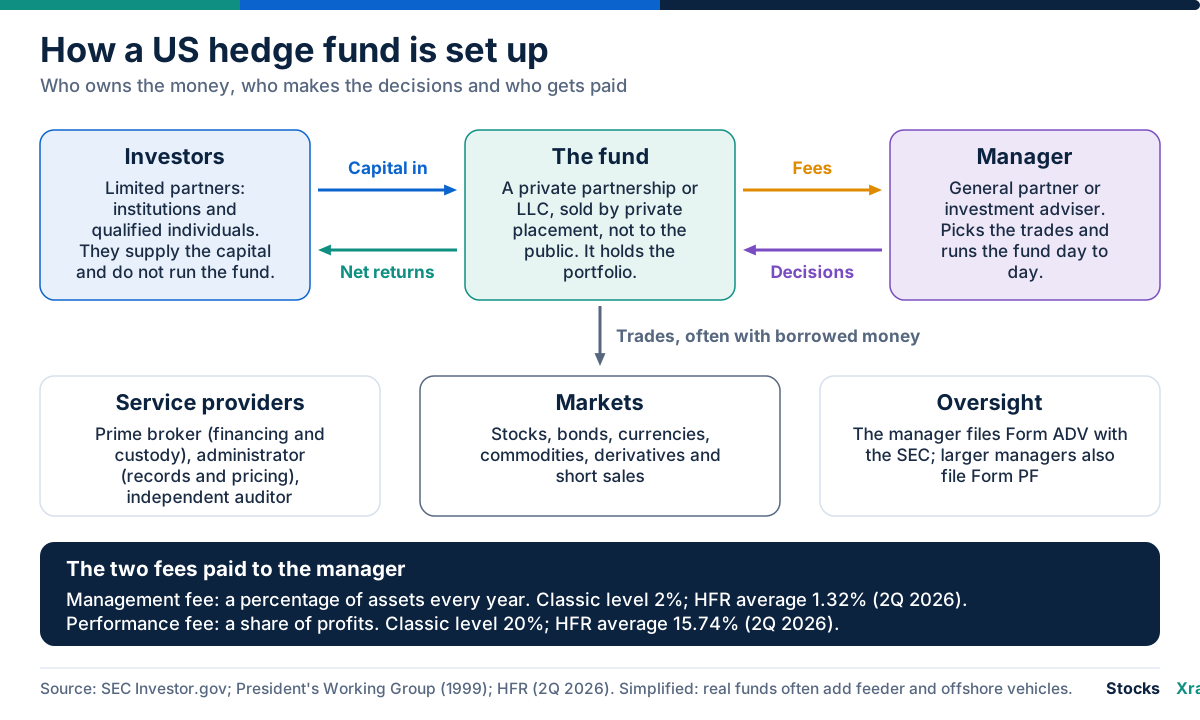
The SEC describes a hedge fund as a private, unregistered investment fund that pools investors' money and invests it to earn positive returns. Compared with a mutual fund or ETF, it has more freedom: it can borrow to increase its exposure (leverage), sell securities short, use derivatives and hold assets that are hard to sell. It is not marketed to the general public.
There is no legal definition of the term. A 1999 report by the President's Working Group on Financial Markets noted that "hedge fund" is not defined or used in the federal securities laws. For reporting, the SEC's Form PF treats a private fund as a hedge fund if it meets any one of three tests: the manager may be paid a performance fee that counts unrealized gains; the fund may borrow more than half its net asset value or hold gross exposure above twice it; or the fund may sell short (other than to hedge currency or manage duration).
The name is older than the industry. In early 1949 Alfred Winslow Jones, a sociologist and financial journalist, set up a partnership that is usually regarded as the first hedge fund. According to the Bank for International Settlements, he combined long and short stock positions with leverage so that market-wide moves would cancel out and stock selection would drive the result, hence "hedge". Many funds today take large directional bets, often with borrowed money, so "hedge" does not mean "safe".
The industry is large. Hedge Fund Research (HFR) estimated total hedge fund capital at about $5.63 trillion at the end of the second quarter of 2026, a record and the latest figure available when this article was written. The Federal Reserve tracks total assets instead, about $13.7 trillion at the end of September 2025, a different measure. Our guide to the biggest hedge funds in the USA profiles the largest managers.
How a hedge fund is structured in the United States
Most US hedge funds are limited partnerships or limited liability companies, structures that pass taxable income through to investors. The investors are limited partners: they supply money, share in profits and losses, and have no say in individual trades. The manager, usually a general partner or an affiliated investment adviser, makes the investment decisions and receives the fees.
Outside firms support the fund: a prime broker that finances trades and holds assets, an administrator that keeps records and calculates the fund's value, and an independent auditor.
Private placement. Hedge funds sell interests through private placements, usually under Rule 506 of Regulation D. Under Rule 506(b) the fund cannot advertise and may sell to at most 35 non-accredited buyers with enough financial knowledge, although most accept only accredited investors. Under Rule 506(c) the fund may advertise, but every buyer must be accredited and the fund must take reasonable steps to verify it.
Why it is not a mutual fund. A pooled fund open to many investors would normally have to register under the Investment Company Act of 1940. Most hedge funds avoid this by relying on one of two exclusions:
- Section 3(c)(1) covers a fund whose securities are beneficially owned by no more than 100 persons and that makes no public offering.
- Section 3(c)(7) covers a fund owned only by qualified purchasers, again with no public offering. The section sets no maximum number of owners.
Outside the Act, these funds do not have to redeem shares daily, limit their leverage or give the disclosure that mutual funds provide. They remain subject to the same fraud prohibitions as any market participant, and managers owe a fiduciary duty to their funds.
Who can invest: accredited investors, qualified purchasers and qualified clients
Three wealth tests apply, each from a different law. Which ones matter depends on how the fund is built.
| Test | Where it comes from | Individuals | Entities |
|---|---|---|---|
| Accredited investor | Securities Act, Regulation D, Rule 501(a) | Income above $200,000 in each of the last two years ($300,000 jointly) with the same expected this year, or net worth above $1 million excluding the primary residence; or a Series 7, 65 or 82 license in good standing; also certain insiders and "knowledgeable employees" of a private fund | Total assets above $5 million (not formed to buy the securities), or an institution such as a bank, insurer or registered adviser |
| Qualified purchaser | Investment Company Act, section 2(a)(51) | At least $5 million in "investments" as the SEC defines them | At least $25 million in investments, for a buyer acting for its own account or for other qualified purchasers |
| Qualified client | Investment Advisers Act, Rule 205-3 | $1.4 million managed by the adviser, or net worth of $2.7 million excluding the primary residence (since 29 June 2026; previously $1.1 million and $2.2 million) | Looks through to the owners in some structures |
Two practical points follow. First, the accredited-investor dollar figures are written into the rule and are not indexed to inflation; the rule text we checked in October 2026 still used them. Second, passing a test only makes a person eligible. Each fund sets its own minimum, and there is no regulatory standard. Industry guides commonly cite roughly $250,000 to $1 million for many funds and far more for flagship funds.
The qualified-client test matters because the Investment Advisers Act generally bars an SEC-registered adviser from charging a share of capital gains. The law carves out funds that rely on Section 3(c)(7) and allows performance fees for qualified clients. For a 3(c)(1) fund, the SEC rule treats each owner as a client who must meet the test.
How hedge fund fees work: management fee, performance fee and 2 and 20
A hedge fund usually charges two fees. The management fee is a percentage of the fund's assets, charged every year whether the fund makes or loses money. The performance fee, or incentive fee, is a share of profits. The classic structure was "2 and 20": 2% of assets plus 20% of profits. The SEC describes today's typical range as 1% to 2% for the asset fee and 15% to 20% for the performance fee, and warns that a performance fee can motivate a manager to take greater risks.
Actual averages are lower. HFR's second-quarter 2026 data, released in October 2026, put the industry average management fee at an estimated 1.32% and the average incentive fee at 15.74%. Funds launched in that quarter averaged 1.26% and 17.5%. Averages hide wide differences, so a fund's own documents are the only reliable guide.
Two terms limit when the performance fee applies. A high-water mark is the highest value on which a fee has been paid. After a loss, the manager earns no performance fee until the value climbs back above that mark. A hurdle rate is a minimum return the fund must beat before it can charge a performance fee. The SEC lists both as measures that can limit performance fees; each fund's offering documents set the details.
Worked example: $10 million over three years (illustrative)
The figures are illustrative round numbers, not a real fund. Assumptions: a 2% management fee on the value at the start of each year, a 20% performance fee on profit above the high-water mark after the management fee, no hurdle, and fees paid at year end. Real funds usually accrue fees monthly or quarterly.
| Year | Start of year | Gross return | Management fee | Performance fee | End of year | Net return |
|---|---|---|---|---|---|---|
| 1 | $10,000,000 | +20% | $200,000 | $360,000 | $11,440,000 | +14.4% |
| 2 | $11,440,000 | -15% | $228,800 | $0 | $9,495,200 | -17.0% |
| 3 | $9,495,200 | +20% | $189,904 | $0 | $11,204,336 | +18.0% |
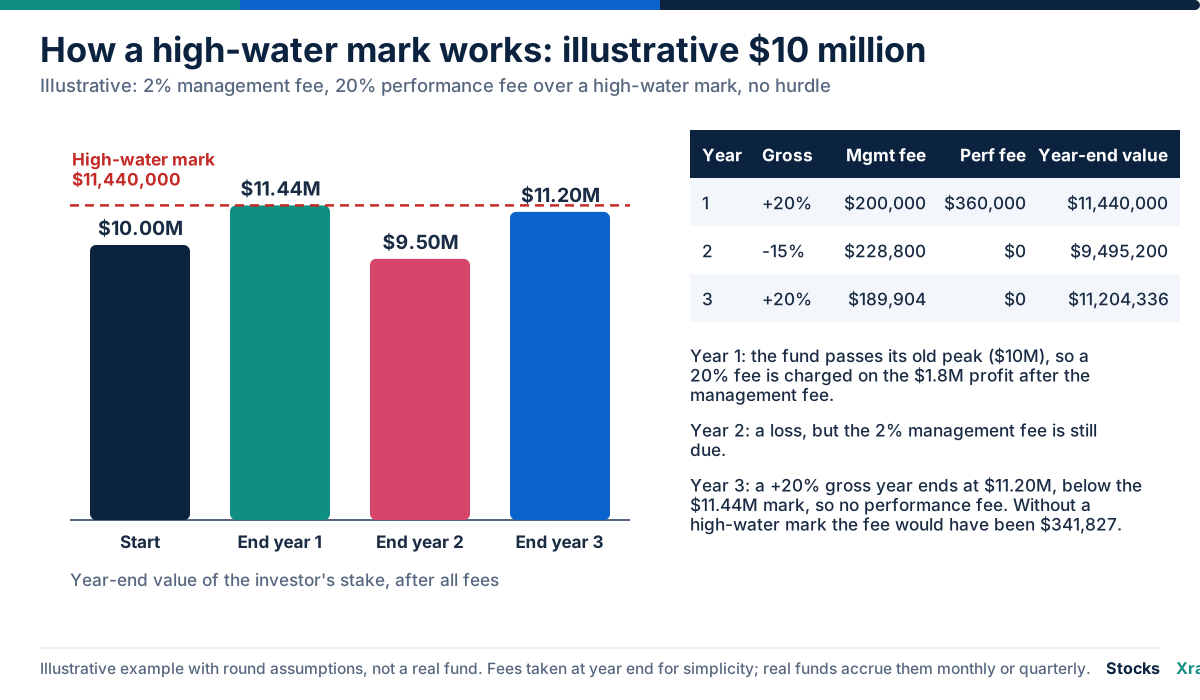
Year 1. The fund gains 20% before fees. After the $200,000 management fee, profit above the old peak of $10 million is $1.8 million, so the performance fee is $360,000. The investor ends at $11,440,000, which becomes the high-water mark.
Year 2. The fund loses 15%. The $228,800 management fee is still due, and there is no performance fee.
Year 3. The fund gains 20%, but the year-end value after the management fee, $11,204,336, is still below the $11,440,000 mark, so no performance fee is due. Without a high-water mark, the manager would have charged 20% of the year's $1.7 million profit, or $341,827.
The gross returns compound to $12,240,000 before fees, about 7.0% a year. The investor ends with $11,204,336, about 3.9% a year. Fees paid total $978,704, and counting the growth those dollars would otherwise have earned, the investor keeps about $1.2 million of the $2.24 million gross profit.
Fee drag at different returns
The management fee is charged in every scenario; the performance fee appears only with a profit above the high-water mark. The table shows one year, with the fund starting at its high-water mark and no hurdle.
| Return before fees | Fees at 2 and 20 | Net return at 2 and 20 | Fees at the 2Q 2026 industry average | Net return at the average |
|---|---|---|---|---|
| +10% | 3.6 points | +6.4% | 2.7 points | +7.3% |
| +5% | 2.6 points | +2.4% | 1.9 points | +3.1% |
| 0% | 2.0 points | -2.0% | 1.3 points | -1.3% |
Funds of hedge funds add a second layer: investors pay the fund-of-funds manager on top of the underlying funds' fees, the SEC notes.
How hedge funds invest: leverage, short selling, derivatives and concentration
A hedge fund's freedom comes from four tools, and each adds risk as well as opportunity.
- Leverage means borrowing to hold more than the fund's own capital. The SEC warns that it magnifies both gains and losses and can turn an otherwise conservative investment into an extremely risky one. Our guide to margin and leverage explains the mechanics.
- Short selling means selling a security the fund does not own, hoping to buy it back cheaper. It profits from falling prices but exposes the fund to uncapped losses. See short selling explained.
- Derivatives such as options and futures let a fund take large positions with little cash. See options basics and futures basics.
- Concentration. Some funds hold a few large positions, which can raise returns when the idea works and cause deep losses when it does not.
Leverage changes outcomes most. As an illustration, a fund with $100 million of investor capital holding $300 million of positions has gross exposure of three times its capital, so a 5% fall in those positions costs $15 million, or 15% of capital. Borrowing costs follow interest rates. The Federal Reserve's May 2026 Financial Stability Report said hedge fund leverage was at record-high levels for the period with comprehensive data, and skewed toward larger funds.
The main hedge fund strategies
HFR groups hedge funds into a few families. Real funds often blend them.
| Strategy family | What it tries to do | Example firm, in its own words |
|---|---|---|
| Equity hedge (long/short equity) | Buy stocks expected to rise and short stocks expected to fall, adjusting how much market risk the fund carries | None named here |
| Event-driven | Profit from corporate events such as mergers, restructurings and bankruptcies, or by pushing for change at a company (activism) | Elliott Investment Management says it often takes a leading role in event-driven situations across the capital structure |
| Macro | Trade interest rates, currencies, commodities and stock indexes on views about the economy; includes systematic trend-following funds known as CTAs | Bridgewater describes itself as a global macro investment firm |
| Relative value | Exploit small price gaps between related instruments, which usually requires leverage to be worth the effort | The Federal Reserve cites cash-futures basis trades and swap spread trades as examples |
| Multi-manager ("pod shop") | A central firm allocates capital to many independent teams, each with strict risk limits | Millennium describes itself as a global, diversified alternative investment firm with many investment teams |
Quantitative methods cut across these families; Renaissance Technologies, for example, says it uses mathematical and statistical methods. For profiles of the firms behind each style, see our guide to the biggest hedge funds in the USA.
Hedge fund vs mutual fund vs ETF vs private equity
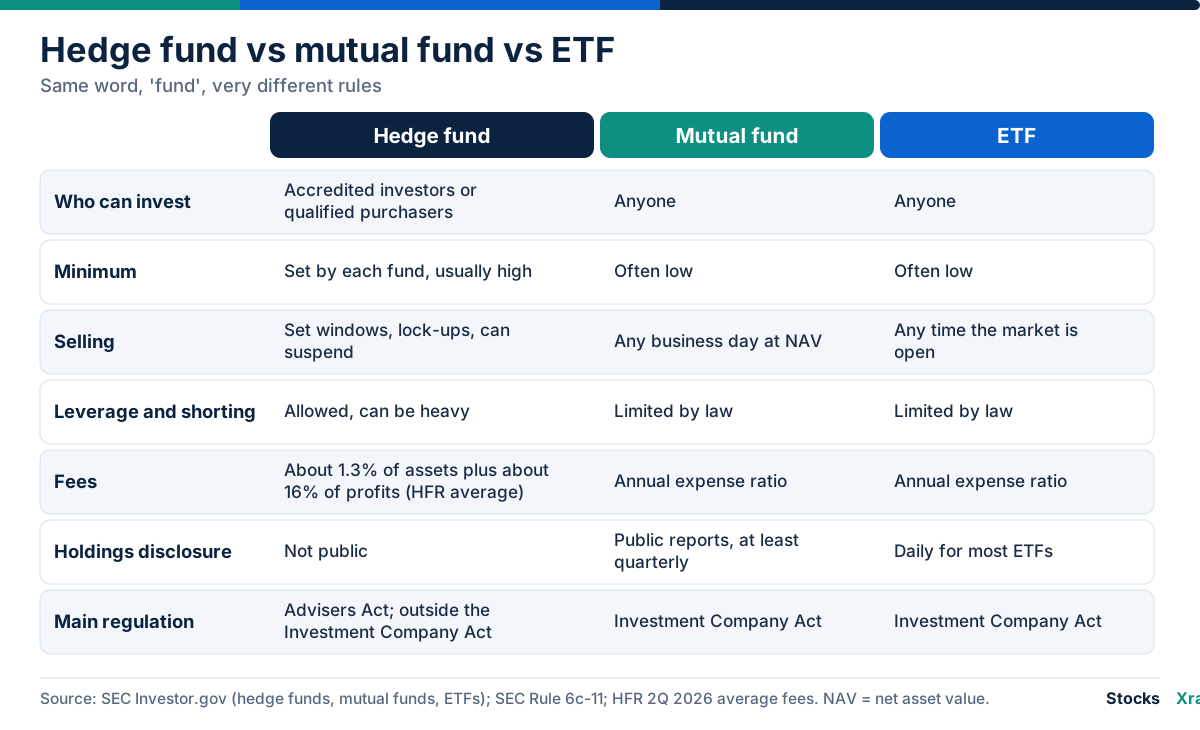
All four pool money, but the rules differ sharply.
| Hedge fund | Mutual fund | ETF | Private equity fund | |
|---|---|---|---|---|
| Who can invest | Accredited investors or qualified purchasers, depending on structure | Anyone | Anyone | Typically accredited investors and qualified clients |
| Selling | Set redemption dates, often four or fewer a year; lock-up of a year or more is common; the fund may suspend withdrawals | Any business day at net asset value | Any time the market is open, at the market price | Typically illiquid; investment horizon often 10 years or more |
| Regulation | Fund outside the Investment Company Act; adviser regulated under the Advisers Act; fraud rules apply | Registered under the Investment Company Act; limits on illiquid assets and borrowing | Registered under the Investment Company Act | Fund not registered; adviser may be |
| Fees | Management fee plus performance fee (2Q 2026 averages 1.32% and 15.74%) | Annual expense ratio | Annual expense ratio | Management fee plus share of profits, set in fund documents |
| Transparency | No public holdings; regulators see more | Public reports at least quarterly | Daily holdings for most ETFs | No regular public disclosure |
| Typical minimum | Set by each fund; commonly cited $250,000 to $1 million or more | Many set a relatively low amount | The price of a share | Often very high |
For a plain comparison of the retail products, see ETF vs mutual fund vs individual stock and what is an ETF.
Liquidity: lock-ups, notice periods and gates
Mutual fund investors can sell on any business day. Hedge fund investors usually cannot. The SEC says hedge funds typically limit redemptions to four times a year or fewer, often impose a lock-up of one year or more, may charge a redemption fee, and may have authority to suspend redemptions in times of market distress or when investments cannot be sold quickly.
Four terms appear in most offering documents:
- Lock-up: an initial period during which an investor cannot withdraw.
- Notice period: advance written notice an investor must give before a redemption date.
- Gate: a limit on how much of the fund can be withdrawn on one date, so heavy withdrawals do not force the fund to dump positions.
- Suspension: the manager's right to stop withdrawals altogether.
These terms exist because holdings may take time to sell. If many investors left at once, the manager would sell the best assets first, leaving the remaining investors with the rest. Form PF asks managers what share of a fund could be suspended or gated.
A real example of a suspension. In December 2008, after steep losses that year, Citadel told investors it was halting year-end withdrawals from its two largest funds, Kensington and Wellington. A right to redeem is only as strong as the fund's terms, and the terms matter most in a crisis.
Regulation and transparency: what the SEC sees and what the public sees
Hedge funds are lightly regulated compared with mutual funds, but not unregulated. Anti-fraud rules apply in full, and several other layers add to them:
- Offering rules. Private placements must fit an exemption such as Rule 506, which limits who can buy and how the fund is marketed.
- Adviser registration. The Dodd-Frank Act repealed the old "private adviser" exemption. An adviser managing $150 million or more in US private fund assets generally has to register with the SEC under rules that took effect in July 2011. Smaller advisers can rely on an exemption but still file reports as exempt reporting advisers.
- Form ADV. Registered advisers file Form ADV, searchable on the SEC's Investment Adviser Public Disclosure site. Part 1A asks about the private funds the adviser manages.
- Form PF. SEC-registered advisers with at least $150 million in private fund assets file Form PF, which helps the Financial Stability Oversight Council monitor systemic risk. Advisers with at least $1.5 billion in hedge fund assets file quarterly and in more detail. The SEC says it does not intend to make adviser-identifiable data public.
The rules are still moving. The compliance date for 2024 Form PF amendments is now July 1, 2027, and in April 2026 the SEC and CFTC proposed raising the filing threshold from $150 million to $1 billion and the large hedge fund adviser threshold from $1.5 billion to $10 billion. These are proposals, not rules. In June 2024 a federal appeals court also vacated the SEC's 2023 private fund adviser rules, which had covered quarterly statements and audits.
What the public can see. Large managers also file Form 13F. The SEC requires institutional managers with at least $100 million in certain US-listed securities to file it within 45 days of each quarter end, and it lists long positions only, not short positions. Futures data offer another window: the CFTC's weekly report for financial futures has a "leveraged funds" category that is typically hedge funds and similar managers. Our Commitments of Traders pages track weekly positioning.
Performance: what the evidence shows
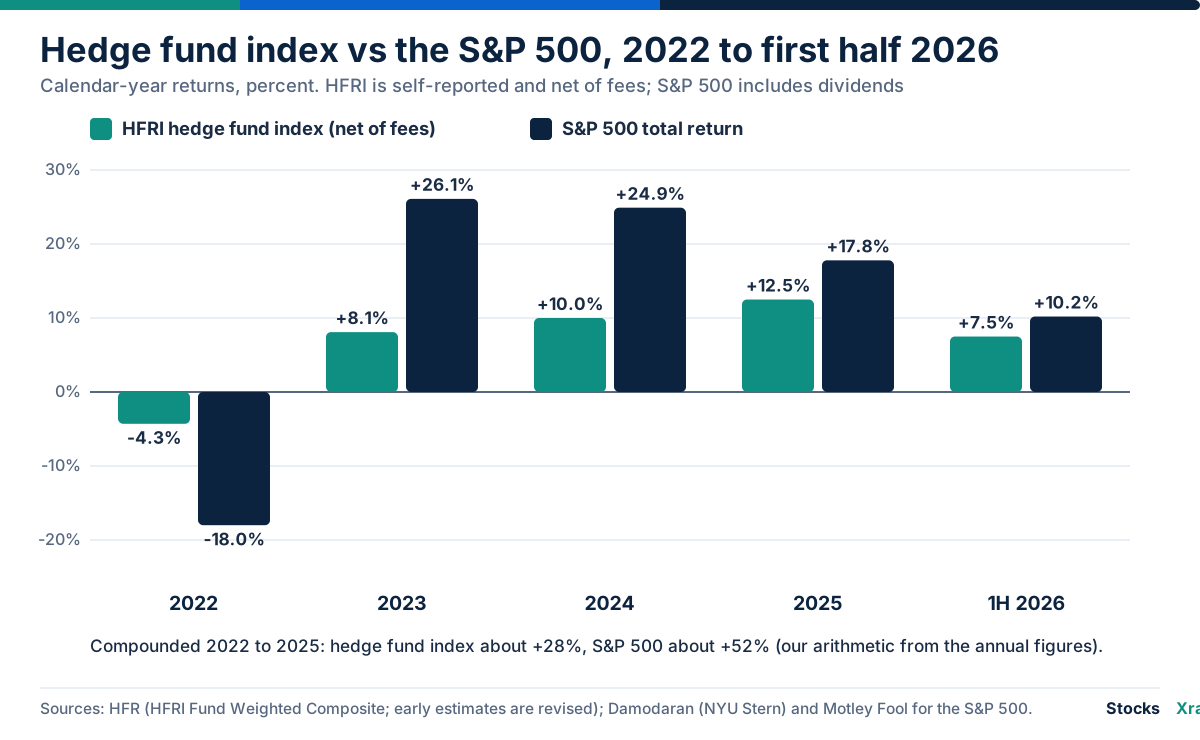
Measuring hedge fund returns is harder than it looks. HFR's main index, the HFRI Fund Weighted Composite, is built from more than 1,000 single-manager funds that choose to report monthly returns, net of all fees, to HFR. Most HFRI indices are equally weighted, and funds of hedge funds are excluded. Nobody audits the whole universe.
| Period | HFRI hedge fund index | S&P 500 total return |
|---|---|---|
| 2022 | -4.3% | -18.0% |
| 2023 | +8.1% | +26.1% |
| 2024 | +10.0% | +24.9% |
| 2025 | +12.5% | +17.8% |
| First half 2026 | +7.5% | +10.2% |
The chart shows a pattern more than a verdict. In the four rising periods it covers, the hedge fund index trailed the stock market, and in the one falling year, 2022, it lost far less. Compounded over 2022 to 2025, our arithmetic from the annual figures gives roughly +28% for the hedge fund index and +52% for the S&P 500. The comparison is imperfect, since hedge funds do not aim to match a stock index. Our Market Compass shows the market regime in which a result was earned, and our stock market indices pages cover the equity benchmark.
The Buffett bet. In December 2007 Warren Buffett bet that an S&P 500 index fund would beat a group of hedge funds over ten years. Protégé Partners picked five funds of funds that together owned stakes in more than 200 hedge funds. From 2008 to 2017, Berkshire Hathaway reported, the index fund gained 125.8% while the five funds of funds gained between 2.8% and 87.7%. The funds of funds lost less in 2008 (16.5% to 30.1% against 37.0%). It is one ten-year period and covers funds of funds with two fee layers.
Academic evidence. Ibbotson, Chen and Zhu studied about 8,400 funds from 1995 to 2009. They split pre-fee returns of about 11.1% a year into fees of about 3.4%, alpha (return not explained by market exposure) of about 3.0% and market exposure of about 4.7%. After adjusting for survivorship and backfill bias, the equal-weighted net return was 7.70% a year, slightly below the S&P 500's 8.04%.
Why averages flatter. Bing Liang's 2000 study found that survivorship bias, the effect of poor funds dropping out of databases, exceeded 2% a year. HFR counted an estimated 129 fund liquidations in the first quarter of 2026 and 70 in the second. Dispersion is wide too: in the second quarter of 2026 the top tenth of HFRI funds averaged +31.6% and the bottom tenth -8.7%, so the choice of fund matters more than the label.
A risk-adjusted view. A hedge fund's pitch is usually smaller losses and lower volatility, not the highest return. To test that, compare returns after fees with the Sharpe ratio, the worst peak-to-trough fall (drawdown and risk measures) and how closely the fund moves with the stock market.
Famous failures and what they teach
Long-Term Capital Management (1998). LTCM, founded in 1994 by John Meriwether, traded relative value positions that depended on price gaps between related securities narrowing. The President's Working Group reported total assets of $129 billion at the end of 1997, balance-sheet leverage of 28 to 1 and over-the-counter derivatives with a notional value of $1.3 trillion. After Russia devalued the ruble and declared a debt moratorium on 17 August 1998, risk spreads widened instead of narrowing, and the fund lost 44% of its value in August alone. On 23 September 1998, 14 banks and brokerages invested $3.6 billion for 90% of the fund, at talks hosted by the New York Fed, which did not commit its own money. The lessons: leverage turns a bad month into a threat to lenders, portfolios that look diversified can fall together, and large positions are hard to exit.
Amaranth Advisors (2006). Amaranth lost about $6 billion in September 2006, with press reports giving figures up to $6.4 billion, mostly on natural gas spread trades run by its energy desk. The fund later wound down. The lesson is concentration: one large bet in one market can end a fund that looked diversified across strategies.
How an ordinary investor can get similar exposure
None of these is a substitute for a hedge fund, and none is a recommendation. Each has trade-offs:
- Liquid alternative funds. These mutual funds or ETFs, registered under the 1940 Act, use short selling, derivatives and other hedge-fund-style strategies. The SEC notes they are open to the public, must let investors sell at any time, face limits on illiquid investments and borrowing, and often charge 2% a year or less. The trade-offs are complex strategies, expenses that can exceed those of traditional funds, and short track records; many launched after 2008.
- Hedge fund replication funds. Some funds use liquid securities and derivatives to track the return pattern of a hedge fund index. They follow a statistical pattern rather than any actual manager, and they carry derivatives, counterparty and tracking risks.
- Funds that follow disclosed holdings. Some ETFs rebuild portfolios from the positions selected hedge funds disclose publicly, usually rebalancing each quarter. The disclosures they rely on, such as Form 13F, are delayed, list only long positions and miss shorts and derivatives.
- Managed futures funds. These trade futures under commodity trading advisors, usually with systematic, trend-following models. Returns can differ from stocks and bonds, but leverage and derivatives bring risk.
- Your own portfolio. Ideas such as spreading risk and controlling loss size can be applied with ordinary funds. See diversification explained and asset allocation.
For any of these, read the prospectus for fees, leverage, liquidity and how the fund behaved in down markets.
Common mistakes
- Reading "hedge" as "safe". A hedge fund can be more concentrated and more leveraged than an index fund.
- Judging a fund by headline returns. Check whether returns are after fees, over how many years and from which start date. The funds you can see are the ones that lasted.
- Ignoring liquidity terms. Lock-ups, notice periods and gates decide whether you can get your money out when you need it.
- Using the index average to judge one fund. The best and worst tenths of funds in a quarter can be 40 points apart.
- Treating 13F filings as a full portfolio. They show delayed long positions in US-listed securities only.
- Overlooking layers of cost. Funds of funds add a second fee layer, and fund expenses come on top of headline fees.
Frequently asked questions
What is a hedge fund in simple terms? A hedge fund is a private investment fund that pools money from institutions and wealthy individuals. A manager invests it with a wider toolkit than a mutual fund, including short selling, borrowing and derivatives, and is paid a fee on assets plus a share of profits.
How do hedge funds make money? The fund earns returns from its investments, and the manager earns fees from the fund. Returns come from strategies such as buying stocks expected to rise and shorting those expected to fall, trading on economic views, or profiting from corporate events. The manager charges a fee on assets and a share of profits.
What does "2 and 20" mean? It is the classic hedge fund fee: a 2% annual management fee on assets plus a 20% performance fee on profits. HFR's second-quarter 2026 data put the industry averages lower, at about 1.32% and 15.74%. A high-water mark usually stops the performance fee until the fund recovers earlier losses.
Who can invest in a hedge fund? In the United States, investors generally must be accredited investors or qualified purchasers. An individual is accredited with income above $200,000 ($300,000 jointly) or net worth above $1 million excluding the home, and is a qualified purchaser with at least $5 million in investments. Each fund also sets its own minimum.
Are hedge funds regulated? Yes, but more lightly than mutual funds. Managers above certain sizes must register with the SEC and file Form ADV, and those with at least $150 million in private fund assets also file Form PF. The funds sit outside the Investment Company Act, so daily redemption, leverage limits and public disclosure rules do not apply, but anti-fraud rules do.
What is the difference between a hedge fund and a mutual fund? A mutual fund is SEC-registered, open to anyone, redeemable at net asset value on any business day and limited in its use of leverage. A hedge fund is private, limited to qualified investors, usually restricts withdrawals, can use leverage and short selling widely, and charges a performance fee.
Do hedge funds beat the stock market? Not reliably. In 2025 the HFRI hedge fund index gained about 12.5% against about 17.8% for the S&P 500, while in 2022 it lost about 4% against about 18%. Survivorship and self-reporting flatter the averages, and the gap between the best and worst funds is large.
Can I invest in a hedge fund with a small amount of money? Not directly, because of the wealth tests and fund minimums. Liquid alternative mutual funds and ETFs offer some similar strategies with low minimums and daily liquidity, but they are different products with their own risks.
Sources and data notes
- SEC Investor.gov: hedge funds, the SEC hedge fund investor bulletin, mutual funds, ETFs, private equity and alternative mutual funds.
- Law and rules: Regulation D Rules 501 and 506, Investment Company Act sections 2(a)(51) and 3(c), Advisers Act section 205 and Rule 205-3, the 2026 qualified client adjustment as reported by Foley Hoag, SEC Form PF, SEC release IA-3222 and the SEC Form 13F FAQ.
- Industry data: Hedge Fund Research market commentary and HFRI methodology.
- History and risk: President's Working Group, Hedge Funds, Leverage, and the Lessons of LTCM (1999); Federal Reserve History, LTCM; Federal Reserve Financial Stability Report (May 2026); BIS Quarterly Review (November 2000).
- Performance: Berkshire Hathaway 2017 letter; Ibbotson, Chen and Zhu; Liang; S&P 500 returns from Damodaran and Motley Fool.
All figures are as of October 2026 unless stated. The worked fee example and the fee-drag table are illustrative. HFRI returns are early estimates that HFR later revises. Fund minimums and lock-up terms vary by fund and are not set by regulators. This article does not cover tax, offshore structures or how to choose a specific fund.
Educational information, not financial advice.
Related reading
Educational only, not financial advice. Examples use illustrative numbers.