Form 13F Explained: What It Shows, What It Hides and How to Read It
13F filings are the quarterly reports in which large US investment managers list the stocks, ETFs and some options they held on a quarter's last day. A manager with discretion over at least $100 million in qualifying securities must file Form 13F with the US Securities and Exchange Commission (SEC) within 45 days after each quarter ends. This guide covers who files, what counts, how to read a real information table, what the form leaves out, and how it differs from Schedules 13D and 13G and Form 4.
Key takeaways
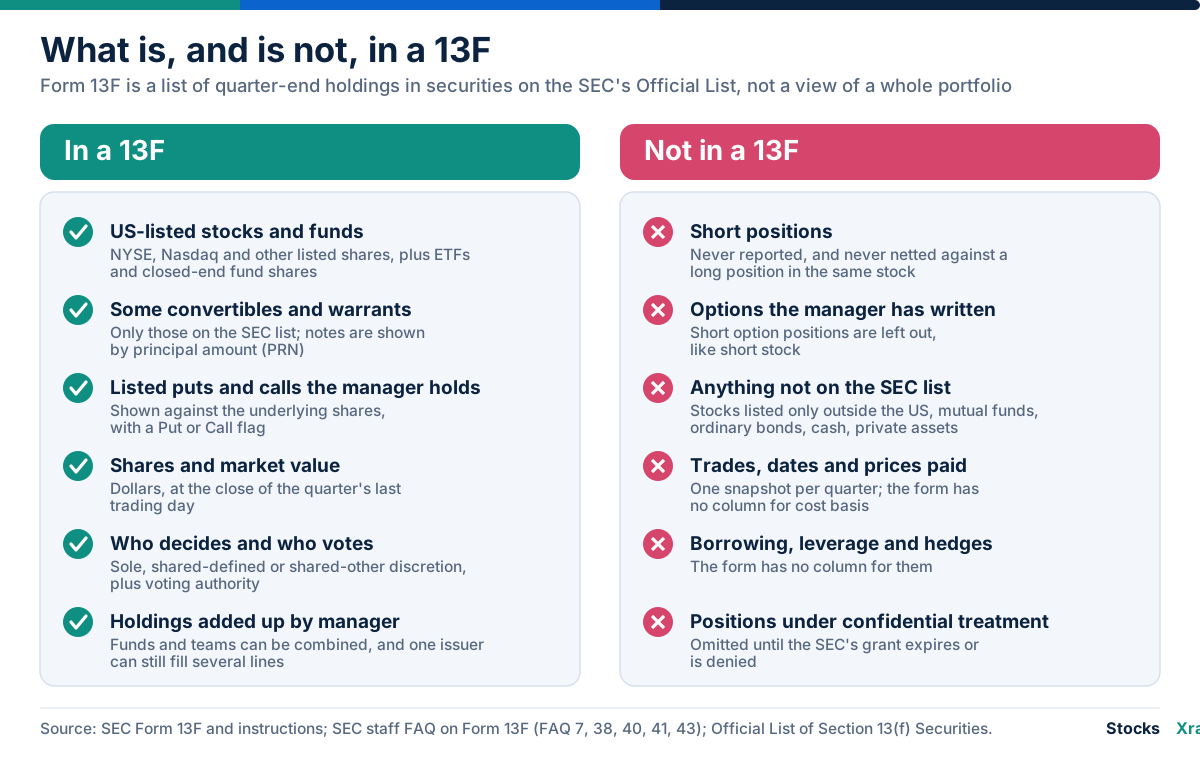
- A 13F is a delayed snapshot of long positions. It lists holdings in securities on the SEC's official list as of the last day of a quarter and is due 45 days later. For the quarter ended 30 June 2026 the deadline was 14 August 2026, and about one in five original reports arrived on that final day.
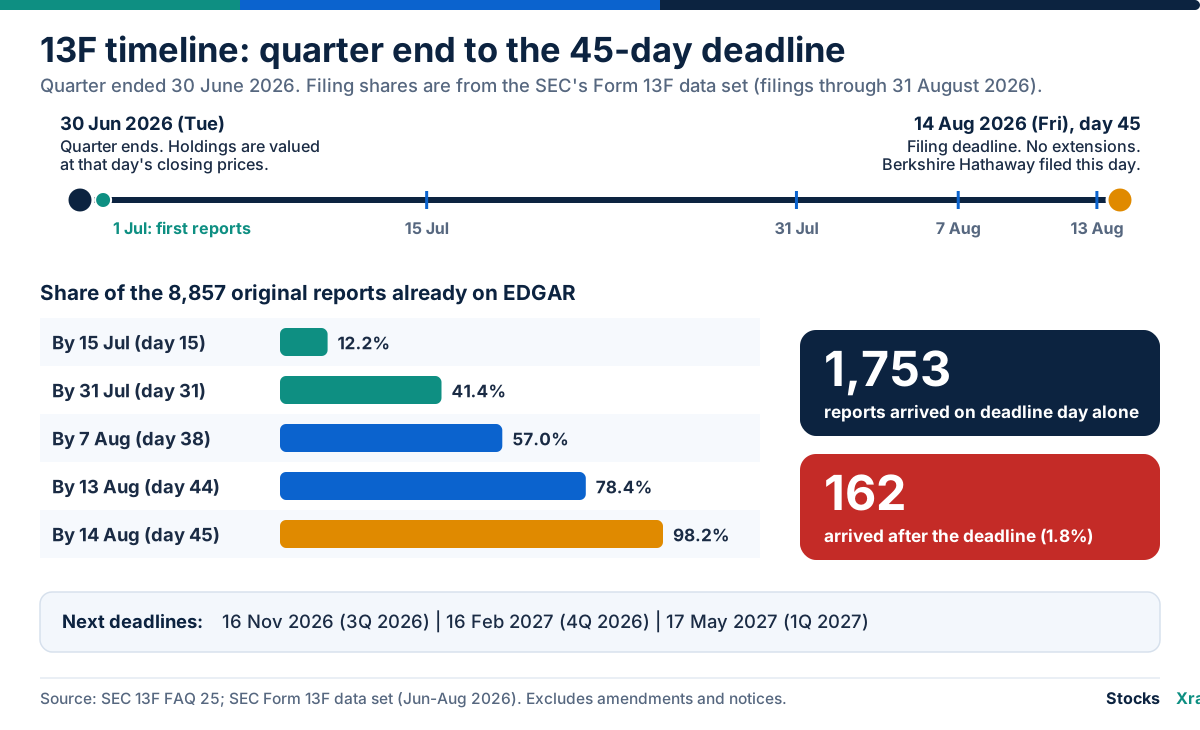
- It leaves out most of what a fund does. Short positions, written options, stocks listed outside the US, ordinary bonds, cash, private assets, trades, prices paid and borrowing are all absent.
- Lines are not positions. Berkshire Hathaway's June 2026 report has 89 lines but only 29 securities, and Apple alone fills 12 lines. Add lines by CUSIP, and read Put and Call lines separately, because they are valued at the underlying shares.
- A change in value is not a trade. Berkshire reported the same 227,917,808 Apple shares at 31 March and 30 June 2026, yet the reported value rose 14.0% because the price rose.
- Schedules 13D and 13G and Form 4 answer different questions. They cover one company and one owner. A 13D is due five business days after a stake passes 5% and a Form 4 two business days after an insider trade, while a 13F covers a whole book and is due 45 days after quarter end.
What Form 13F is and why it exists
Form 13F is the report that institutional investment managers file under Section 13(f) of the Securities Exchange Act of 1934. Congress added that section in 1975. The SEC says the aim was to increase public availability of information about institutional holdings, and Congress expected the program to raise investor confidence in the integrity of US markets. In 2020 the SEC also described the data as a way to weigh the influence of large managers when it works to keep markets fair and orderly.
The form is a disclosure of positions, not a performance report. It says nothing about returns, fees or risk, and it is not limited to hedge funds: banks, insurers, pension funds, broker-dealers and mutual fund advisers file it too. For hedge fund basics, see what is a hedge fund, and for the largest managers see the biggest hedge funds in the USA.
Public Form 13F filings are on the SEC's EDGAR system. The SEC also publishes flattened quarterly data sets built from the filings. The set covering June to August 2026 holds 8,857 original holdings reports for the quarter ended 30 June 2026, and it carries the SEC's warning that the agency cannot guarantee the accuracy of data that filers supply.
Who must file Form 13F
An institutional investment manager must file if it exercises investment discretion over accounts holding Section 13(f) securities with a combined fair market value of at least $100,000,000 on the last trading day of any month in a calendar year. The $100 million figure appears in the statute (Section 13(f)(1)) and in the SEC's Rule 13f-1.
The SEC defines the manager broadly. It is any entity that invests for its own account or exercises discretion over other people's accounts, which covers banks, insurance companies, broker-dealers, registered advisers, corporations and pension funds that run their own portfolios, government bodies, and foreign managers that use US interstate commerce. A person who invests only their own money is not a manager. Investment discretion means the power to decide which securities are bought or sold, and a parent company is treated as sharing discretion over accounts that a controlled subsidiary runs.
Once a manager reaches the threshold at any month-end, it owes four reports: one for the December quarter of that year and one each for March, June and September of the next year, even if its holdings later fall below $100 million. Consistent with that rule, 881 of the 8,857 original reports for the June 2026 quarter show a table total under $100 million.
The June 2026 data set also shows the scale. It holds 8,857 holdings reports (form type 13F-HR) and 1,936 notices (13F-NT, explained below). The median holdings report has 102 lines, and 4,385 reports list 100 lines or fewer. The longest lists 229,522.
Rule check, 19 October 2026. The eCFR text of Rule 13f-1, current to 15 October 2026, still reads $100,000,000 and 45 days. The SEC proposed raising the threshold to $3.5 billion in July 2020, and the rule text shows that proposal was not adopted. We found no adopted 2026 change to the threshold or the deadline rule. The SEC's staff FAQ was last reviewed on 28 September 2026.
What counts as a Section 13(f) security
Rule 13f-1 defines a Section 13(f) security as an equity security of a class described in Section 13(d)(1) of the Exchange Act (in broad terms, a registered class) that is admitted to trading on a national securities exchange or quoted on an automated quotation system of a registered securities association. In practice a manager relies on the SEC's Official List of Section 13(f) Securities, which the SEC updates every quarter. As of 19 October 2026 the current edition is the one for the third quarter of 2026. Only securities on the list count toward the threshold, and only they may be reported.
| Instrument | On a 13F? | Detail |
|---|---|---|
| Common stock listed on NYSE, Nasdaq or another US exchange | Yes | Foreign companies count only if their shares trade in the US; "pink sheet" ADRs do not |
| ETF shares and closed-end fund shares | Yes | Both are on the official list |
| Open-end mutual fund shares | No | Not on the list |
| Certain convertible notes and warrants | Yes, if on the list | Notes are reported by principal amount (PRN) rather than shares |
| Put and call options the manager holds | Yes, if on the list | Shown against the underlying stock with a Put or Call flag |
| Options the manager has written | No | Not reported and not netted against long positions |
| Short positions in stock | No | Not reported and not subtracted from long positions |
| Stocks listed only outside the US | No | For example Toronto, London or Tokyo listings |
| Cash, ordinary bonds, Treasury bills, private companies, loans | No | Not on the list, so not reportable |
Four details change how a table reads. A manager may leave out a holding of fewer than 10,000 shares worth less than $200,000 (both tests must be met). Securities that a manager owns and has lent out are reported by the owner. Values use the close of trading on the last trading day of the quarter and the trade date, not the settlement date. For the $100 million test only the value of the options themselves counts, but in the table an option line is described in terms of the underlying shares and valued at them.
A manager with sole discretion may also add up its holdings in each issuer and share class, and the SEC's own example does not split them by individual or account. A 13F therefore generally cannot show which fund or team holds what. For background on the products involved, see what an ETF is and options basics.
Filing deadlines and the 2026 calendar
The deadline is 45 days after the end of each calendar quarter, counted in calendar days. If day 45 falls on a weekend or federal holiday, the filing is due the next business day. The SEC grants no extensions, so a late filer should file as soon as it can. We computed each date below and checked it against the SEC staff FAQ's table.
| Positions as of | Day 45 | Deadline | Why it moves |
|---|---|---|---|
| 31 Dec 2025 | Sat 14 Feb 2026 | Tue 17 Feb 2026 | Weekend, then Presidents Day on 16 Feb |
| 31 Mar 2026 | Fri 15 May 2026 | Fri 15 May 2026 | None |
| 30 Jun 2026 | Fri 14 Aug 2026 | Fri 14 Aug 2026 | None |
| 30 Sep 2026 | Sat 14 Nov 2026 | Mon 16 Nov 2026 | Weekend |
| 31 Dec 2026 | Sun 14 Feb 2027 | Tue 16 Feb 2027 | Weekend, then Presidents Day on 15 Feb |
| 31 Mar 2027 | Sat 15 May 2027 | Mon 17 May 2027 | Weekend |
The deadline shapes when information appears. In the SEC data set, the first report for 30 June 2026 arrived on 1 July. Of the 8,857 original reports, 1,083 (12.2%) were filed by 15 July, 3,671 (41.4%) by 31 July, 5,050 (57.0%) by 7 August and 6,942 (78.4%) by 13 August. Another 1,753 arrived on 14 August itself, which brings the total to 98.2% by the deadline, and 162 (1.8%) came after it but by 31 August, the end of the data set. Looking for a given manager's report in early July often finds nothing yet, and a report read on 14 August is already 45 days old.
How a Form 13F is built
A Form 13F has three parts: a cover page, a summary page and an information table. The cover page gives the manager's name, address and Form 13F file number (it starts with 028-), the report type and the signer. The summary page gives the number of table entries, the table's total value, the list of other included managers and a box that shows whether any holdings were left out under a confidential treatment request. The information table holds the positions.
Filers submit the table in XML on EDGAR, and each filing page shows it as a document labeled Information Table. The old text format ended on 20 May 2013. Since 3 January 2023 values are reported to the nearest dollar, where earlier reports rounded to the nearest thousand, so compare old and new filings with care.
| EDGAR form type | What it is | Q2 2026 reports in the SEC data set |
|---|---|---|
| 13F-HR | Holdings report, or a combination report when part of the holdings sit in another manager's filing | 8,857 |
| 13F-HR/A | Amendment to a holdings report | 143 |
| 13F-NT | Notice: the manager's holdings are all reported by another manager, so it files a cover page only | 1,936 |
| 13F-NT/A | Amendment to a notice | 4 |
| 13F-CTR | Confidential treatment request, filed separately with the SEC | Not part of the public data set |
The information table has eight columns, plus an optional FIGI identifier.
| Column | What it holds | How to read it |
|---|---|---|
| 1. Name of issuer | The company, spelled as on the SEC list | The spelling can change between quarters |
| 2. Title of class | Common stock, Class A shares, notes and so on | One issuer can have several classes |
| 3. CUSIP | A nine-character security identifier | The reliable key for matching filings |
| 4. Value | Dollars at the quarter-end close | Divide by shares to get the price used |
| 5. Shares or principal amount | SH for shares, PRN for principal, plus Put or Call for options | A Put or Call flag means the line is an option |
| 6. Investment discretion | SOLE, DFND (shared-defined) or OTR (shared-other) | DFND is the category for controlling and controlled companies |
| 7. Other manager | Numbers that point to the Summary Page list | Blank when discretion is not shared with a listed manager |
| 8. Voting authority | Shares with sole, shared or no voting power | Routine-only voting counts as none |
Worked example: Berkshire Hathaway's report for 30 June 2026
The example is the Form 13F-HR that Berkshire Hathaway Inc filed on 14 August 2026, day 45, for the quarter ended 30 June 2026 (EDGAR accession 0001193125-26-352200). It is a very large filer with a table short enough to read. Everything below is data from the filing and from the SEC's own lists, not a view on any stock.
The cover page names the manager (Berkshire Hathaway Inc, Omaha, Nebraska), Form 13F file number 028-04545 and the report type: 13F holdings report. The summary page reports 89 table entries, a table value total of $299,253,556,246 and 14 other included managers. They are insurers and other group companies such as GEICO Corp and National Indemnity Co, plus an entry for Warren E. Buffett. The confidential-treatment box is not ticked.
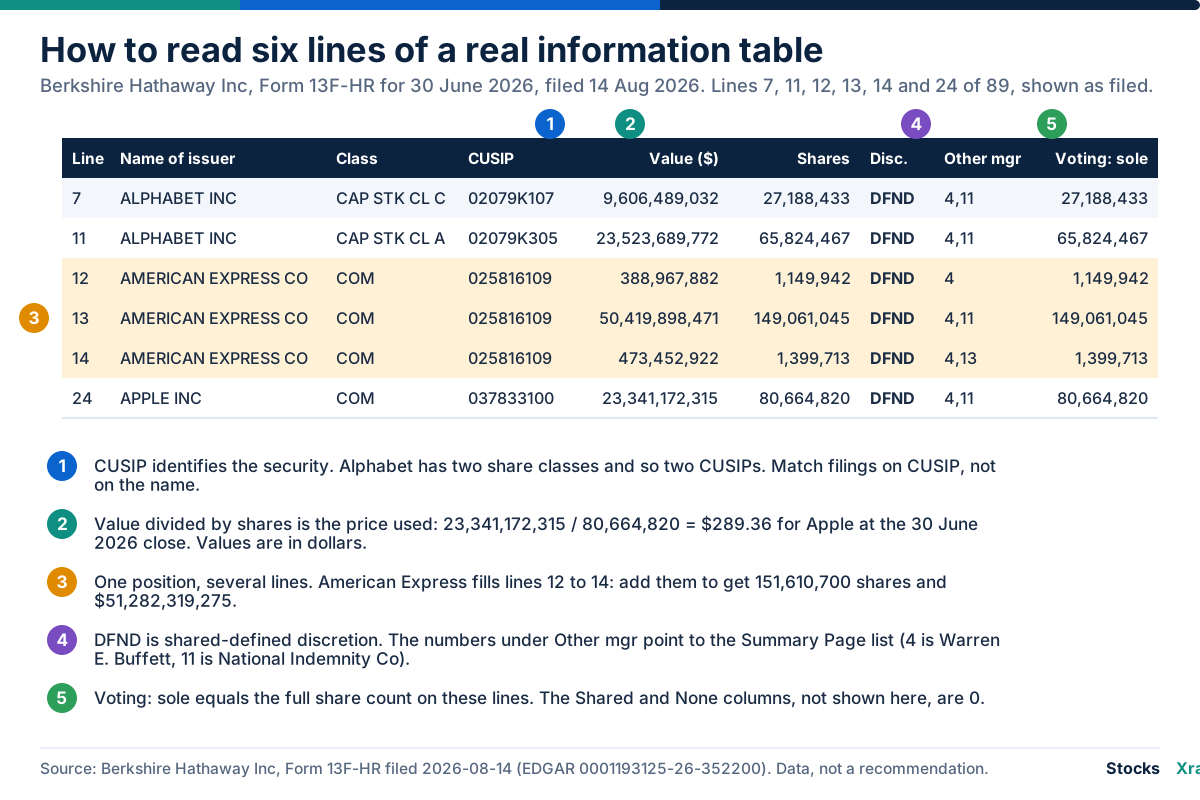
Here are the same six lines as text. Lines 12 to 14 are all American Express.
| Line | Issuer | Class | CUSIP | Value ($) | Shares | Discretion | Other manager |
|---|---|---|---|---|---|---|---|
| 7 | ALPHABET INC | CAP STK CL C | 02079K107 | 9,606,489,032 | 27,188,433 | DFND | 4,11 |
| 11 | ALPHABET INC | CAP STK CL A | 02079K305 | 23,523,689,772 | 65,824,467 | DFND | 4,11 |
| 12 | AMERICAN EXPRESS CO | COM | 025816109 | 388,967,882 | 1,149,942 | DFND | 4 |
| 13 | AMERICAN EXPRESS CO | COM | 025816109 | 50,419,898,471 | 149,061,045 | DFND | 4,11 |
| 14 | AMERICAN EXPRESS CO | COM | 025816109 | 473,452,922 | 1,399,713 | DFND | 4,13 |
| 24 | APPLE INC | COM | 037833100 | 23,341,172,315 | 80,664,820 | DFND | 4,11 |
Read the identifiers first. Alphabet has two share classes, so it has two CUSIPs, 02079K107 for Class C and 02079K305 for Class A. Every line in this report is DFND, shared-defined discretion, the category the form uses for controlling and controlled companies. The numbers in the last column point to the Summary Page list, where 4 is Warren E. Buffett and 11 is National Indemnity Co. On all 89 lines the sole voting authority equals the share count, and the shared and none columns are zero.
Check the arithmetic. Value divided by shares gives the price used at quarter end. Line 24 gives $289.36 for Apple, and every other Apple line gives the same number. Lines 12 to 14 give $338.25 for American Express. If the result looks nothing like a share price, suspect an error in the filing.
Add the lines. The 89 lines cover 29 securities (CUSIPs) from 26 issuers. Adding lines for the same issuer gives the positions below.
| Issuer | Lines | Shares | Value at 30 Jun 2026 | Share of table value |
|---|---|---|---|---|
| Apple Inc | 12 | 227,917,808 | $65,950,296,923 | 22.0% |
| American Express Co | 3 | 151,610,700 | $51,282,319,275 | 17.1% |
| Alphabet Inc (Class A and Class C) | 5 | 105,979,600 | $37,764,088,383 | 12.6% |
| Coca-Cola Co | 10 | 400,000,000 | $32,508,000,000 | 10.9% |
| Bank of America Corp | 8 | 483,394,015 | $27,543,790,975 | 9.2% |
| Chevron Corp | 4 | 84,375,856 | $13,986,141,890 | 4.7% |
The five largest issuers make up 71.9% of the table's value. That is a share of what the filing lists, not of everything Berkshire owns. The filing uses the SEC list's spellings, such as BANK OF AMER CORP and CHEVRON CORPORATION. Our pages for Apple, American Express, Alphabet, Coca-Cola and Bank of America show each company's fair value range and X-Ray Score; the 13F itself says nothing about whether any price is high or low.
Comparing two quarters
Berkshire's report for 31 March 2026 (accession 0001193125-26-226661, filed 15 May 2026) has 90 lines and a table total of $263,095,703,570. Putting four securities side by side shows what a 13F can and cannot say.
| Security | Shares, 31 Mar to 30 Jun | Value, 31 Mar to 30 Jun | Implied price per share |
|---|---|---|---|
| Apple | 227,917,808 to 227,917,808 | $57,843,260,493 to $65,950,296,923 | $253.79 to $289.36 (+14.0%) |
| Chevron | 84,375,856 to 84,375,856 | $17,457,364,606 to $13,986,141,890 | $206.90 to $165.76 (-19.9%) |
| Alphabet Class C | 3,585,215 to 27,188,433 | $1,028,454,775 to $9,606,489,032 | $286.86 to $353.33 |
| Bank of America | 513,624,165 to 483,394,015 | $25,039,178,044 to $27,543,790,975 | $48.75 to $56.98 |
Apple and Chevron show no change in reported shares, so their changes in value of +14.0% and -19.9% are price moves, not trades. Alphabet Class C and Bank of America show changes in reported shares (+23,603,218 and -30,230,150). That is the most a filing allows you to say: it does not show when in the quarter the shares changed hands, at what price, or why.
The names also moved. Bank of America appears as BANK AMERICA CORP in the March report and BANK OF AMER CORP in the June one, because filers copy names from the SEC's list and the list changed between its first- and second-quarter 2026 editions (Chubb changed from CHUBB LTD SWITZ to CHUBB LIMITED in the same way). The CUSIP, 060505104, stayed the same. Matching by name would show Bank of America as a sold-out holding and a new one.
What a 13F does not show
| Missing piece | Why it is missing | What it means when you read a table |
|---|---|---|
| Short positions | The SEC tells filers not to report them or subtract them from long positions | A long/short fund's 13F is half a picture. See short selling explained |
| Written options and other derivatives | Only held options on the list are reported | Hedges and income strategies can be invisible |
| Non-US holdings | Stocks listed only outside the US are not reportable | Global funds look smaller and more US-centered than they are |
| Cash, ordinary bonds, private assets | They are not on the SEC list | A table total is not the whole portfolio |
| Timing inside the quarter | Positions are a quarter-end snapshot | A position bought and sold within the quarter never appears |
| Cost, price paid, borrowing, leverage | The form has no column for them | You cannot tell profit, risk taken or financing |
| Team or fund detail | Managers may add up holdings across accounts and teams | You generally cannot tell which strategy owns what |
| Positions under confidential treatment | Omitted until the SEC's grant expires | Delayed by up to a year (see below) |
A table total is not assets under management. It is the gross market value of the reported lines, and option lines carry the value of the underlying shares. The Q2 2026 reports below show how different the shapes are. All were filed on 13 or 14 August 2026.
| Filer | Lines | Table total | Put and call lines | Share of table value in put and call lines |
|---|---|---|---|---|
| Berkshire Hathaway Inc | 89 | $299.3 billion | 0 | 0% |
| Renaissance Technologies LLC | 3,140 | $72.6 billion | 0 | 0% |
| Bridgewater Associates, LP | 997 | $24.4 billion | 0 | 0% |
| Elliott Investment Management L.P. | 29 | $22.7 billion | 12 | 37.0% |
| Millennium Management LLC | 5,798 | $276.3 billion | 1,957 | 46.4% |
| Citadel Advisors LLC | 16,127 | $875.1 billion | 7,627 | 80.1% |
In Citadel Advisors' report, put and call lines carry about four-fifths of the $875.1 billion, and the lines without a Put or Call flag total $174.2 billion. Reading the whole table as stock owned would make the filer's stock lines look about five times larger than they are. These totals are also not comparable with the assets-under-management figures in our hedge fund rankings, which measure something else.
The staleness problem. A position is measured at the quarter-end close and public up to 45 days later. By the deadline day for the June 2026 quarter, about half of the next quarter had gone, and the filer may have bought, sold or hedged since. A snapshot cannot show the path between two snapshots.
Short positions may get their own filing, but not yet. In 2023 the SEC adopted Rule 13f-2 and Form SHO, which would have managers report short positions to the SEC monthly, with only aggregated data published. On 3 December 2025 the SEC granted an exemption from compliance until 2 January 2028, after a federal appeals court sent the rules back for more economic analysis. As of 19 October 2026 managers are not yet required to file Form SHO, and Form 13F still excludes shorts.
Confidential treatment and amendments
A manager can ask the SEC to keep certain holdings out of the public report. The SEC may delay or prevent disclosure within the Freedom of Information Act's limits, and the usual commercial grounds are an ongoing program of buying or selling or an open risk-arbitrage position. Information that identifies securities held by a natural person, an estate or a personal trust is protected by statute, and a grant on that basis lasts indefinitely unless circumstances change. The manager files the omitted holdings separately (form type 13F-CTR) and ticks a box on the public summary page. A commercial request can start at three, six, nine months or one year, measured from the date the report is due, and it may not exceed one year.
When a request is denied or a grant expires, the manager has six business days to file a 13F-HR/A that adds the holdings, with a legend on the cover page. A real case shows the delay. Berkshire's original report for 31 March 2025, filed on 15 May 2025, had the omitted-holdings flag set and listed 110 lines. On 14 August 2025 it filed an amendment of type "new holdings", with the reason "Confidential Treatment Expired", that added four lines: D.R. Horton (1,512,371 shares, $192,267,725), Lennar Class A (1,929,972 shares, $221,522,186), Lennar Class B (202 shares, $22,032) and Nucor (5,756,510 shares, $692,738,413). Those four lines, worth $1,106,550,356 at 31 March 2025, reached the public three months after the normal deadline. In the SEC data set, 83 of the 8,857 original reports for 30 June 2026 carry the omitted-holdings flag.
Amendments also fix mistakes. A restatement replaces the whole earlier filing, and filers can amend more than once. EDGAR accepting a filing says nothing about whether its content is correct. On 24 August 2026, ten days after the deadline, one state pension system filed a 13F-HR whose Apple line showed a value of 22,278,223 and 6,446,426,607 shares, which would be more than 40% of the 14.59 billion Apple shares outstanding on 17 July 2026. The value and share columns were swapped. It filed a restatement the same day with 22,278,223 shares and a value of $6,446,426,607, which works out to $289.36 per share, the same price Berkshire's report implies. Dividing value by shares exposes this kind of error at once, and two independent filers that imply the same price give extra comfort. Always look for a later 13F-HR/A before relying on a table.
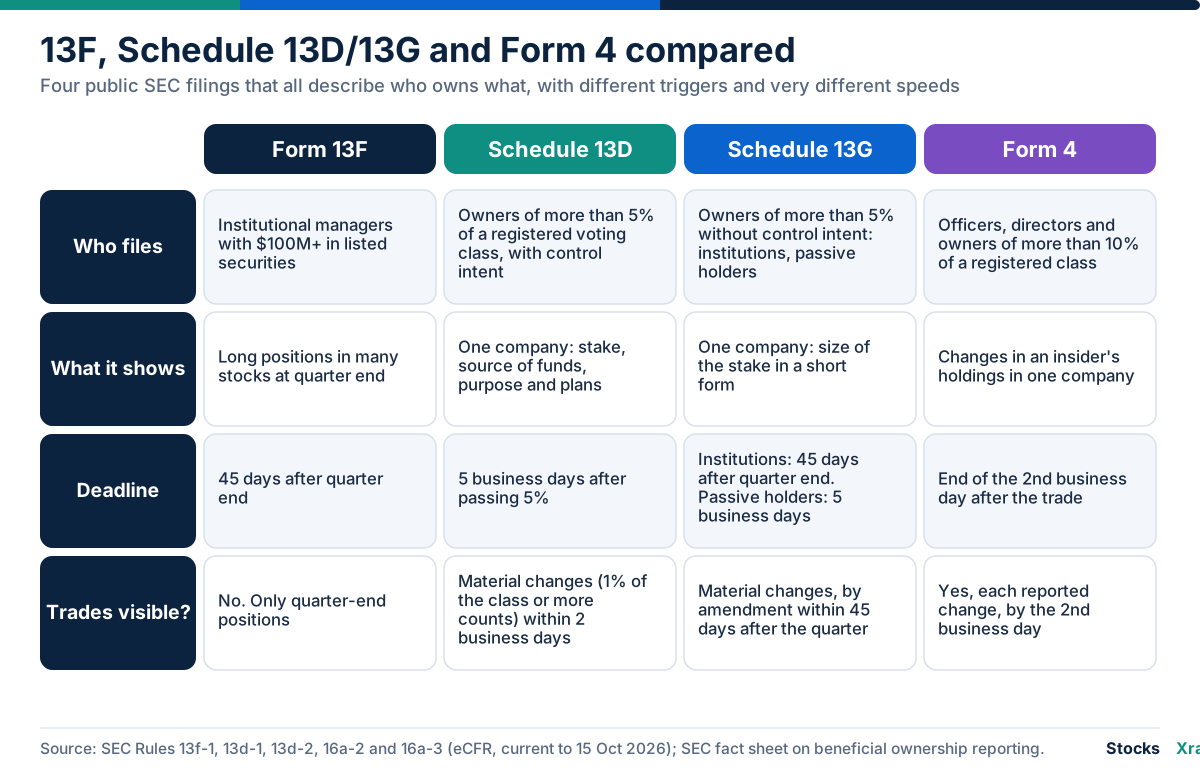
13F, Schedule 13D, Schedule 13G and Form 4 compared
Four SEC filings describe who owns what, with different triggers. Schedule 13D and Schedule 13G cover anyone who owns more than 5% of a registered class of voting stock; Form 4 covers corporate insiders; Form 13F covers managers' quarter-end lists.
| Form 13F | Schedule 13D | Schedule 13G | Form 4 | |
|---|---|---|---|---|
| Who files | Institutional managers with $100 million or more in listed securities | Owners of more than 5% of a registered voting class, with control intent | Owners of more than 5% without control intent: qualified institutions, exempt and passive investors | Officers, directors and owners of more than 10% of a registered class |
| Scope | Many stocks, one manager | One company, one owner | One company, one owner | One company, one insider |
| Shows | Long positions at quarter end | Stake, source of funds, purpose, plans | Stake, in a short form | Changes in the insider's holdings |
| Deadline | 45 days after quarter end | 5 business days after passing 5%; amendments within 2 business days of a material change | Institutions and exempt investors: 45 days after the quarter in which they pass 5% (5 business days after month-end if above 10%); passive investors: 5 business days | Before the end of the 2nd business day after the transaction |
| Trades visible | No | Material changes; 1% of the class or more counts as material | Material changes, in a quarterly amendment | Yes, each reported change |
Since the SEC's modernization of beneficial ownership reporting, the 13D initial deadline is five business days, down from 10 days, and 13G amendments are due 45 days after the quarter in which a material change occurs. The SEC fact sheet set 30 September 2024 as the compliance date for the revised Schedule 13G deadlines. For insider filings see insider buying and selling, and for other company filings see 10-Q, 8-K and proxy statements.
Common mistakes
- Treating a 13F as a full portfolio. The table omits shorts, cash, bonds, non-US stocks and private assets, and its total is not assets under management.
- Reading a change in value as a trade. Value moves with price. Compare share counts across quarters, and remember that a share change does not show when, at what price or why.
- Miscounting lines. One issuer can fill a dozen lines, as Apple does in Berkshire's report. Add lines by CUSIP once, match filings by CUSIP and not by name (names change with the SEC list, and one issuer can have several classes), and do not add a parent's report to subsidiary holdings that the parent already includes, since the form's instructions aim to prevent duplicate reporting.
- Ignoring Put and Call lines. A Put or Call line is valued at the underlying shares and is not stock owned. Separate those lines before totaling anything.
- Treating a 13F as a buy signal. The filing is dated, partial and silent about reasons. Apple appears in more than 6,000 of the 8,857 reports for the June 2026 quarter, so appearing on a 13F says little by itself. The SEC's 2020 proposal discussed front-running and copycatting of disclosed positions as indirect costs for smaller managers. For the psychology, see herd behavior.
- Confusing a 13F with a 13D, 13G or Form 4. A 13F is a periodic list, while the others report stakes and insider trades within days.
Finding and reading 13F data
- Search EDGAR for the manager by name or CIK number and filter the filing list to form type 13F.
- Open the latest 13F-HR. The primary document holds the cover and summary pages, and the Information Table document holds the positions.
- Check the list of 13F-HR/A amendments for the same period and use the latest restatement.
- Match positions across quarters by CUSIP, divide value by shares for a price check, and add lines for the same CUSIP.
- For many filers at once, use the SEC's quarterly Form 13F data sets, and read the SEC's disclaimer first.
StocksXray does not publish 13F holdings. The filings list on a stock page such as Apple's shows recent 10-Q and 8-K filings with EDGAR links, not 13F data. For another public positioning data set, our Commitments of Traders pages track the CFTC's weekly futures positioning for 31 markets (see how to read the COT report), and Market Compass puts market conditions in context. The technical scanner works from prices after each US close, and the best dividend stocks list ranks S&P 500 companies by yield, payout and growth.
Frequently asked questions
What are 13F filings? 13F filings are quarterly reports that institutional investment managers file with the SEC on Form 13F. They list the managers' long positions in securities on the SEC's official list, such as US-listed stocks, ETFs and some options, as of the last day of the quarter. The reports are public on EDGAR.
Who has to file a Form 13F? Any institutional investment manager that exercises investment discretion over at least $100 million in Section 13(f) securities on the last trading day of any month in a calendar year. That includes hedge fund advisers, banks, insurers, pension funds, broker-dealers and foreign managers that use US commerce. A person investing only their own money does not file.
When are 13F filings due? Within 45 days after each quarter ends. The 2026 and early 2027 deadlines are 17 February 2026, 15 May 2026, 14 August 2026, 16 November 2026, 16 February 2027 and 17 May 2027. When day 45 falls on a weekend or holiday, the deadline moves to the next business day, and the SEC does not grant extensions.
Does a 13F show short positions? No. The SEC tells filers not to report short positions or to subtract them from long positions, and written options are left out as well. A separate SEC rule would collect short positions, but its compliance date was pushed to 2 January 2028 and only aggregated data would be published.
What is the difference between a 13F and a 13D or 13G? A 13F lists a manager's quarter-end holdings across many companies and is due 45 days after quarter end. Schedules 13D and 13G are filed by owners of more than 5% of one company's registered class. A 13D is due five business days after crossing 5%, and a 13G is due 45 days after the quarter or within five business days, depending on the filer.
How old is the information in a 13F? At filing it is up to 45 days old, because the positions are measured at the quarter-end close and the filing is due 45 days later. Holdings the manager asked to keep confidential can appear up to a year later. Anything the manager did inside the quarter is invisible.
Can you tell what a fund bought or sold from a 13F? Only partly. You can compare reported share counts between two quarters, but not when the change happened, at what price, or why. A change in reported value without a change in shares is a price move. Written options, short positions and non-US stocks never appear.
Where can I find a fund's 13F filing? On the SEC's EDGAR system. Search for the manager, filter to form type 13F, and open the latest 13F-HR and any 13F-HR/A amendment. The SEC also publishes quarterly Form 13F data sets for bulk analysis, though it does not guarantee their accuracy.
Sources and data notes
- SEC: Frequently asked questions about Form 13F (reviewed 28 September 2026); Form 13F and instructions; Official List of Section 13(f) Securities; Form 13F data sets; EDGAR technical specifications; 2020 press release on the proposed threshold.
- Rules (eCFR, current to 15 October 2026): Rule 13f-1, Rule 13d-1, Rule 13d-2, Rule 16a-2, Rule 16a-3; Section 13(f).
- SEC EDGAR XBRL data for Apple's shares outstanding (14,594,180,000 on 17 July 2026, 10-Q filed 31 July 2026); SEC fact sheet on beneficial ownership reporting; SEC order on Rule 13f-2 and Form SHO (3 December 2025) and fact sheet on short sale disclosure.
- EDGAR filings: Berkshire Hathaway Inc Form 13F-HR for 30 June 2026 and 31 March 2026, and its 31 March 2025 report and amendment.
Counts of reports, filing dates, line counts and option shares come from the SEC's Form 13F data set for filings from June to August 2026, using original 13F-HR reports for the quarter ended 30 June 2026 (13F-NT and amendments counted separately). Table totals match each filing's own summary page. Implied prices are our division of reported value by reported shares. The Berkshire figures are as filed and are presented as data, not a recommendation. This article does not cover tax, Section 16 short-swing profit rules or how to value any security. Details of the SEC's rules and lists can change, so check the SEC pages before relying on a date.
Educational information, not financial advice.
Related reading
Educational only, not financial advice. Examples use illustrative numbers.