What Is Forex? How the Currency Market Works: A Beginner's Guide

Forex, short for foreign exchange, is the market where one currency is exchanged for another. It has no central exchange: banks and other dealers trade with each other and with their customers, and the Bank for International Settlements (BIS) put average turnover at about $9.5 trillion a day in April 2025. This guide explains who trades, how a quote and a conversion work, which instruments exist, what a retail forex account really is, and how to check a broker before you send money.
Key takeaways
- Forex is a decentralized, over-the-counter market that trades around the clock on weekdays. The BIS counted about $9.5 trillion a day in April 2025, a record month, with the US dollar on one side of about 89% of trades.
- Dealers and other financial institutions make up about 95% of turnover and companies about 5%. Trades the BIS classes as retail-driven were about 2.5%.
- A quote says how much of the quote currency buys one unit of the base currency: EUR/USD at 1.1000 means one euro costs 1.1000 dollars. The rate you are offered usually differs from the mid-market rate.
- Most turnover is in FX swaps, spot and forwards. A retail "forex account" is usually a leveraged derivative with the broker as your counterparty, and published loss disclosures show that most retail clients lose money.
- Check any provider on a regulator's register before depositing money: the FCA Firm Checker in the UK, NFA BASIC in the US, or the national and ESMA registers in the EU.
What the forex market is
Foreign exchange means swapping one currency for another. A company pays an overseas supplier, a fund buys foreign shares, a bank funds itself in a second currency and a traveler pays abroad. Each of these needs a conversion, and most are carried out with banks and other dealers.
The market is decentralized. There is no single exchange where all trades meet: deals are struck directly between two parties, on electronic platforms, by phone or through brokers, across many venues. A 2017 central-bank speech published by the BIS put it this way: there is no single trading venue and no single price, and trading runs around the clock across several financial centers. The UK, the United States, Singapore and Hong Kong together handle about three-quarters of it, with the UK alone near 38%.
The BIS measures the market every three years in its Triennial Survey, which counts turnover: the value traded in a day, with double counting between dealers removed. Its first release, on 30 September 2025, gave $9.6 trillion a day for April 2025. The final data, published later, put the figure at about $9.5 trillion, up 27% from April 2022. April 2025 was a record month: the BIS estimated that trading around the US tariff announcements added about $1.5 trillion a day. It also calculated that daily turnover is about 30 times daily global GDP and about 70 times daily international trade, so most currency trading is financial rather than payment for goods.
Every trade involves two currencies, so the shares below add up to 200%. The dollar sits on one side of almost nine trades in ten, which is why most of the biggest pairs include it.
| Currency | Share of April 2025 trades (BIS, final) |
|---|---|
| US dollar (USD) | 89.1% |
| Euro (EUR) | 28.5% |
| Japanese yen (JPY) | 16.9% |
| Pound sterling (GBP) | 10.2% |
| Chinese renminbi (CNY) | 8.6% |
| Swiss franc (CHF) | 6.3% |
| Australian dollar (AUD) | 6.1% |
| Canadian dollar (CAD) | 5.8% |
Who trades forex
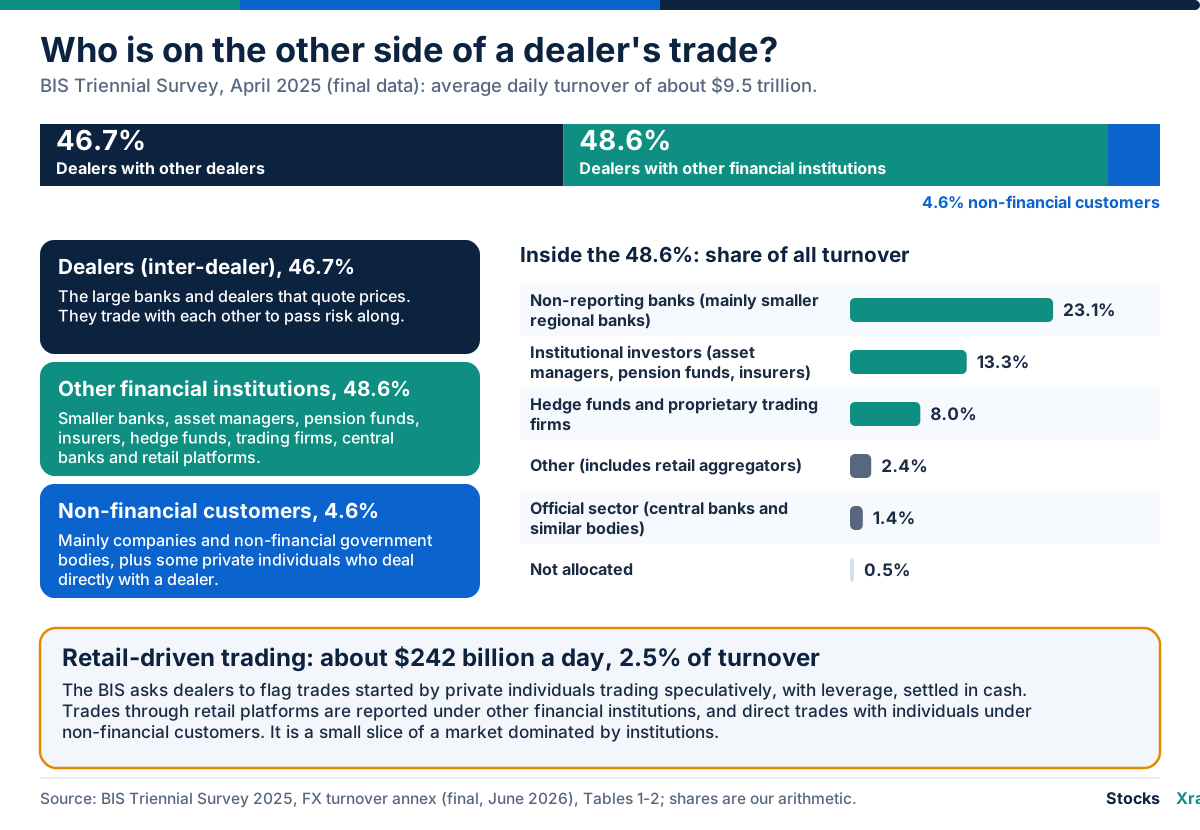
The BIS sorts the other side of each dealer trade into groups, and the first image shows the result for April 2025.
| Group | Who is in it | Share of turnover (BIS, final) |
|---|---|---|
| Dealers trading with each other | Large banks and dealers that quote prices and pass risk between themselves | 46.7% |
| Non-reporting banks | Mainly smaller regional banks | 23.1% |
| Institutional investors | Asset managers, pension funds, insurers | 13.3% |
| Hedge funds and proprietary trading firms | Leveraged investment funds and firms trading for their own account, some at very high speed | 8.0% |
| Official sector | Central banks, sovereign wealth funds, development banks, public international institutions | 1.4% |
| Other and not allocated | Includes retail aggregators | 2.9% |
| Non-financial customers | Mainly companies and non-financial government bodies | 4.6% |
Companies are a small part of turnover even though payments for trade are what most people picture. One company payment can set off several dealer trades, and funds and banks trade currencies for investment and funding reasons of their own.
Retail traders, meaning private individuals, are flagged separately. The BIS asks dealers to report retail-driven trades: those started by private individuals trading for their own account, speculatively, with leverage, settled in cash. Retail platforms that sit between individuals and dealers are reported under other financial institutions, and individuals dealing directly with a dealer under non-financial customers. On that definition retail-driven trading was about $242 billion a day in April 2025, about 2.5% of turnover and about 3.7% of spot trading. It depends on what dealers report, so treat it as an order of magnitude.
Positions in currency futures are a separate, public record. The CFTC publishes who is long and short each week, and our guide to reading the COT report explains the categories. The euro positioning page shows the latest report for the CME euro contract.
How a quote works
A currency pair names two currencies by their three-letter codes. In EUR/USD the euro is the base currency and the US dollar is the quote currency. The rate says how many units of the quote currency one unit of the base costs, so at an illustrative 1.1000, one euro costs 1.1000 dollars. Which currency comes first is a market habit: EUR/USD, GBP/USD, AUD/USD and NZD/USD put the dollar second, while USD/JPY, USD/CHF and USD/CAD put it first, as the forex page lists them.
Buying a pair means buying the base currency and selling the quote currency at the same moment, and selling does the reverse. A dealer shows two prices for the pair: the bid, at which it buys the base currency from you, and a higher ask, at which it sells to you. The gap is the spread, one of the main costs of trading. Pips, lot sizes and the arithmetic of spreads, swaps and leverage are covered in our guide to pips, lots and leverage, and the general mechanics of quotes in the bid-ask spread post.
Converting money: the rate you see and the rate you get
The same number converts money in both directions. To go from the base currency to the quote currency you multiply by the rate, and to go back you divide. The inverse rate is one divided by the rate, so a pair at 1.1000 reads 0.9091 in the opposite direction.
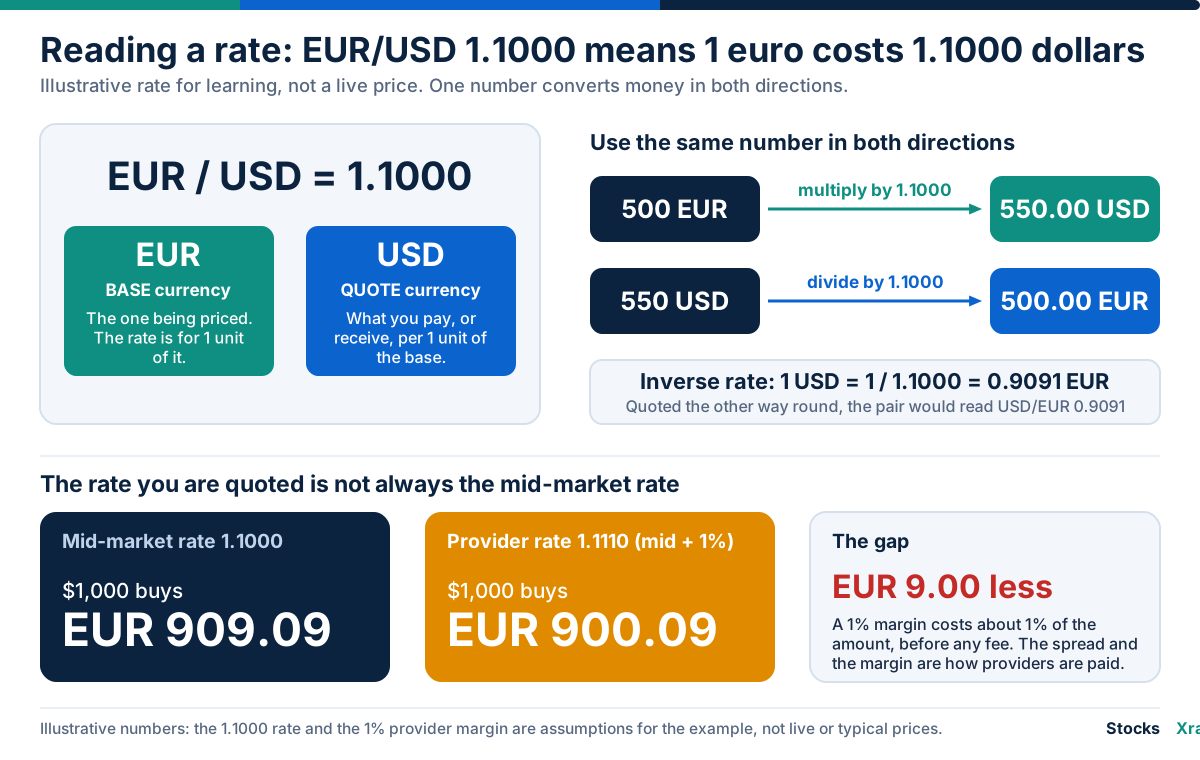
The rate on a data page is usually the mid-market rate, the midpoint between the prices at which dealers buy and sell. Banks, card issuers and money-transfer firms add their own margin and sometimes a fee. Take an illustrative mid-market rate of 1.1000 and $1,000. At the mid-market rate it buys €909.09. At a provider rate of 1.1110, one percent above mid-market, it buys €900.09, which is €9.00 less before any fee. The StocksXray currency converter covers 57 currencies and states that its rates are daily mid-market reference rates, not quotes from a bank, so the rate at your bank will differ. USD to PKR, USD to INR and EUR to USD are examples, each with a chart, a conversion table and the interest rates behind the two currencies.
A few live rates for reference, from our data (the worked examples above do not use them):
| Pair | Latest rate | 1-day change |
|---|---|---|
| EUR/USD | 1.1237 | +0.2% |
| GBP/USD | 1.3327 | +0.4% |
| USD/JPY | 158.030 | 0.0% |
| USD/INR | 94.965 | −0.1% |
| USD/PKR | 276.74 | 0.0% |
Rates as of 16 Oct 2026.
Major, minor and exotic pairs
There is no official list. The three labels are market shorthand, and brokers draw the lines in different places. One US broker's education page, for example, names EUR/USD, USD/JPY, GBP/USD and USD/CHF as the traditional majors, notes that many lists add AUD/USD, USD/CAD and NZD/USD, and calls pairs without the dollar cross pairs. A common reading of "exotic" is a major currency paired with the currency of a smaller or emerging economy, such as USD/TRY or USD/ZAR. Our forex page uses a similar split: majors, crosses and emerging.
Regulators draw their own lines for rules, and the lines differ. The UK Financial Conduct Authority defines a major foreign exchange pair as any two different currencies from the US dollar, euro, yen, pound, Canadian dollar and Swiss franc. Under that rule EUR/GBP counts as a major and AUD/USD does not. In the US, the National Futures Association (NFA) names ten currencies for its lower deposit tier, including the Australian and New Zealand dollars and three Nordic currencies.
Turnover does not follow the labels neatly either. The table uses BIS figures for April 2025, worked out from the BIS final tables.
| Pair | Share of all FX turnover (BIS) | UK "major pair"? | Group on our forex page |
|---|---|---|---|
| EUR/USD | 20.7% | Yes | Majors |
| USD/JPY | 14.4% | Yes | Majors |
| GBP/USD | 7.5% | Yes | Majors |
| USD/CAD | 5.2% | Yes | Majors |
| AUD/USD | 4.9% | No | Majors |
| USD/CHF | 4.8% | Yes | Majors |
| USD/INR | 1.9% | No | Emerging |
| EUR/GBP | 1.8% | Yes | Crosses |
| USD/MXN | 1.4% | No | Emerging |
| NZD/USD | 1.2% | No | Majors |
| EUR/JPY | 1.0% | Yes | Crosses |
| USD/ZAR | 0.8% | No | Emerging |
| USD/TRY | 0.5% | No | Emerging |
The ranking has surprises. USD/CNY (8.2%) and USD/HKD (3.6%) each trade more than NZD/USD, a pair often listed as a major, and the BIS says the top ten pairs all involve the dollar. Turnover is a better guide to how liquid a pair is than its label.
Market hours and sessions
Forex trades 24 hours a day on weekdays because the working day passes from one financial center to the next: Sydney, Tokyo, London and New York. There is no official opening or closing bell. By convention the week starts on Sunday evening in New York and ends on Friday evening, and the sessions follow each city's local business hours.
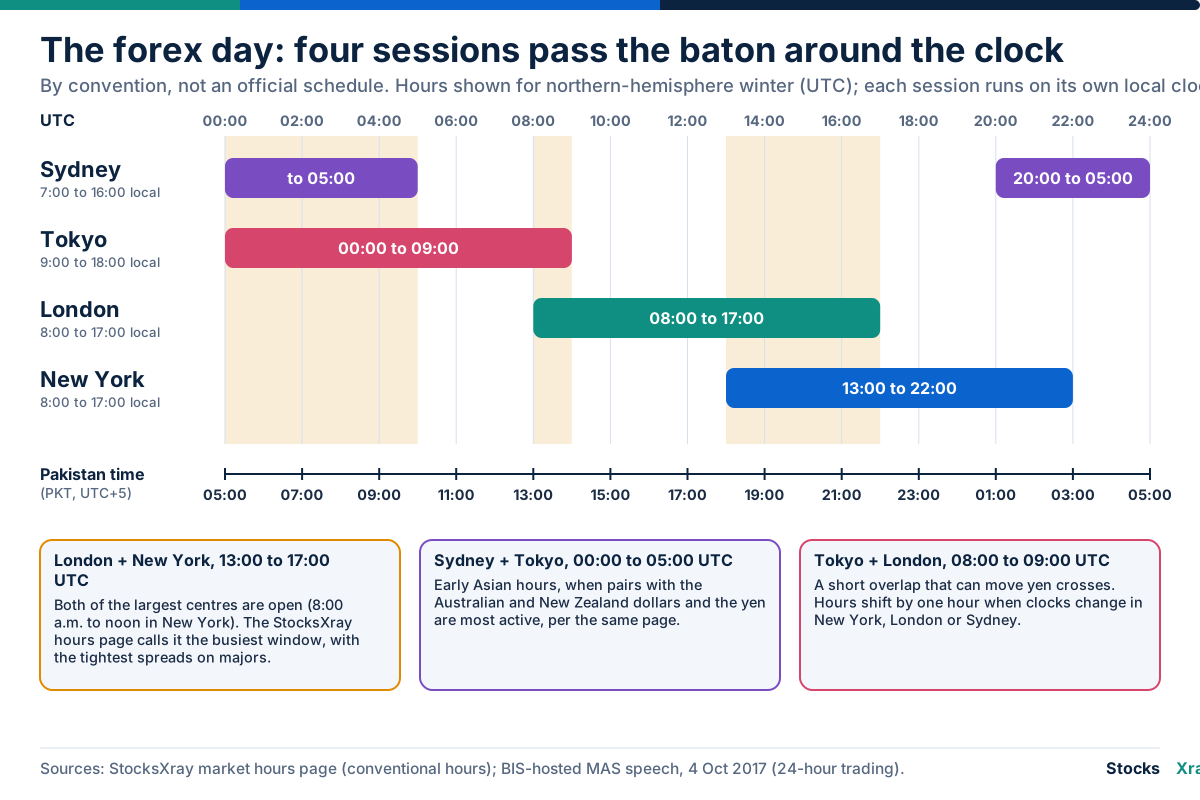
The overlaps matter because two big centers are then open at once. Our forex market hours page describes London and New York together as the busiest window, with the tightest spreads on major pairs, and lists the same hours for Pakistan and India in winter and summer versions. These are habits of the market, not signals, and thin hours can still produce sharp moves on small orders.
Spot, forwards, swaps, options, futures and CFDs
The BIS counts five over-the-counter instruments. All of them exchange or price one currency against another, and they differ in timing and in who uses them.
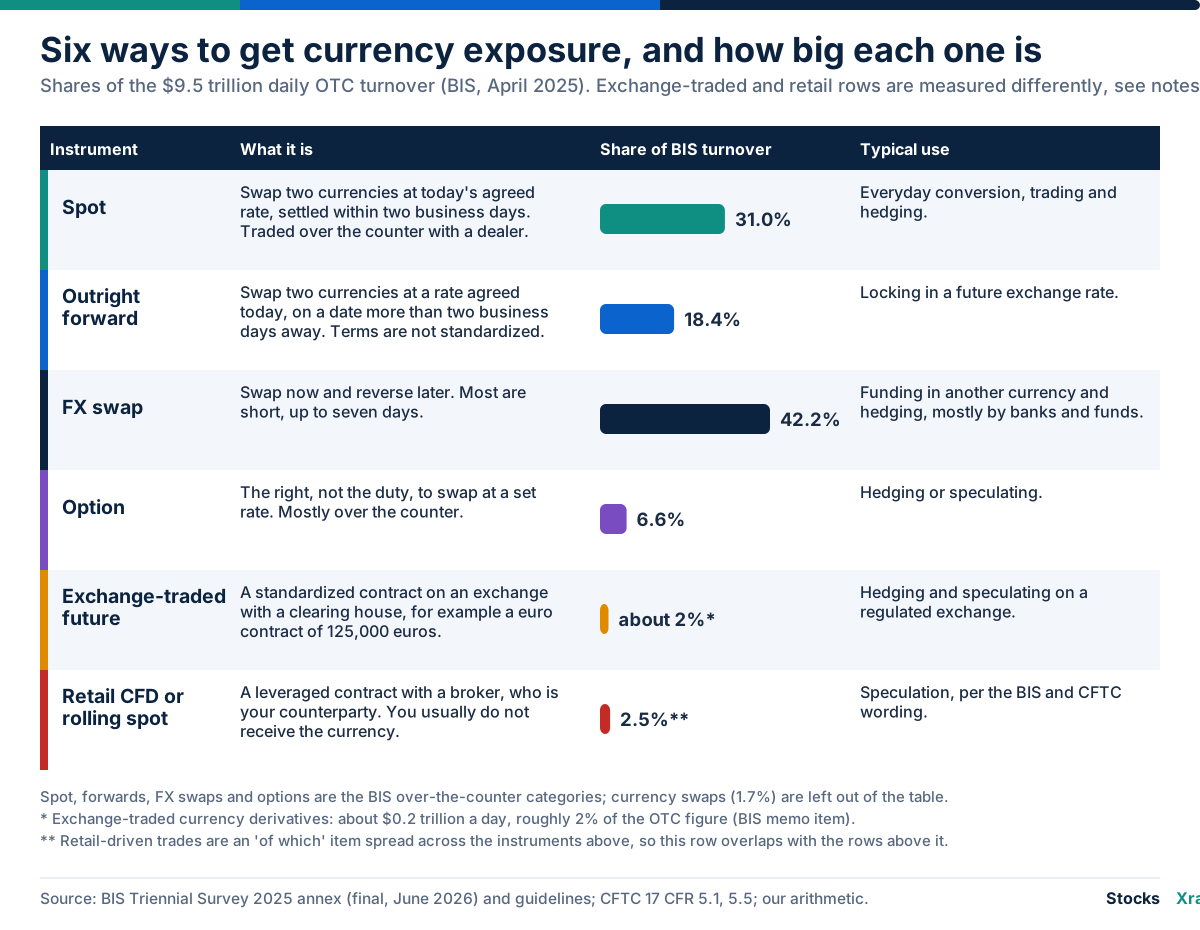
FX swaps are the largest category at 42.2% of turnover, and most are short, up to seven days. They are used to manage funding in different currencies and to hedge, mostly by banks and funds, so a retail trader rarely meets one by that name. Spot is 31.0% and outright forwards 18.4%. A forward is the instrument a company uses to lock in a future rate. The BIS also separates non-deliverable forwards, which settle in cash, and tracks them for several pairs, including USD/INR. Options are 6.6%, and currency swaps, used for longer funding, are 1.7%.
Exchange-traded currency futures and options are a separate and much smaller market, about $0.2 trillion a day, roughly 2% of the over-the-counter figure. The contracts are standardized and cleared through an exchange. Our futures basics and options basics posts explain the mechanics.
A contract for difference (CFD) is different in kind. It pays the change in a price without delivering the currency. The FCA describes CFDs as a way to bet on the price of an asset moving up or down without owning it.
What a retail forex account usually is
A retail forex account is not a bank account. An older joint alert from the CFTC and NASAA, an association of state securities regulators, says it is extremely rare for individual traders to actually see the foreign currency: they close out their commitments and settle gains or losses in cash. Regulators describe the account as a leveraged contract with the firm on the other side.
In the US, the risk disclosure that the CFTC requires dealers to give retail customers (17 CFR 5.5) states that off-exchange forex is leveraged trading of contracts conducted with a futures commission merchant or retail foreign exchange dealer as your counterparty. It adds that when you buy the dealer is the seller and when you sell the dealer is the buyer. It says the trading is not on a regulated market, that the trading platform is only a connection to your dealer, and that deposits have no regulatory protections. The CFTC's August 2022 customer advisory adds that the dealer controls the platform, including the prices on the screen, and that you can close a position only with that dealer.
In the UK, retail forex is generally sold as a CFD, a spread bet or a rolling spot contract. The FCA's 2019 policy statement groups these together as restricted speculative investments. One UK-regulated broker's risk disclosure, dated September 2026, says its products give indirect exposure to an underlying asset such as a currency pair and that you will never own it.
Leverage multiplies both gains and losses on these contracts. Retail leverage on major pairs is capped at 30:1 in the UK and EU and set by a 2% minimum deposit in the US. The arithmetic and the limits are in our pips, lots and leverage guide and the margin and leverage post, and are not repeated here.
What moves exchange rates, and how people use forex
What moves exchange rates
A full treatment is in why currencies move; this is the short version. An exchange rate is the relative price of two economies' money, so anything that changes the appeal of holding one currency against another can move it. The factors usually discussed are interest rates and expected central-bank decisions, inflation, economic growth, trade flows and risk appetite. As of October 2026 the US policy rate is 3.88%, Japan's is 1.25%, India's is 5.50% and Pakistan's is 11.50%; the rates page lists policy rates by country, and each pair page on StocksXray shows the rate gap behind the pair. Over long periods, relative inflation matters too, which is the idea behind purchasing power parity.
No single factor works alone, and the links change over time. The BIS account of April 2025 shows several at once: US tariff announcements early in the month, a falling dollar and low hedge ratios among investors led to a surge in spot and forward trading. The currency strength meter ranks eight major currencies by their average move against the other seven over 1 day, 1 week, 1 month and 3 months, and the Market Compass summarizes the current market regime.
How people actually use forex
Most currency conversion is not speculation. The main uses are these:
- Business payments and hedging. A firm that owes or expects foreign currency can fix the rate with a forward contract. The BIS describes forwards as instruments used to lock in future exchange rates.
- Investing abroad. Holding foreign shares or bonds adds currency exposure. The BIS said institutional investors and asset managers with dollar assets appear to have sold dollars forward in April 2025 to limit further currency losses.
- Travel. Cash at a counter, card payments and ATM withdrawals abroad are currency conversions, but the BIS survey leaves them out of turnover, so they are not part of the $9.5 trillion.
- Remittances. Migrants sending money home convert it at someone's rate. World Bank data show personal remittances received of about $150.7 billion in India and $40.5 billion in Pakistan in 2025, out of $703.6 billion for all low- and middle-income countries.
- Speculation. Funds, trading firms and retail clients take positions on rate moves, which is the use that carries the most risk. One well-known strategy, the carry trade, is explained with worked numbers in carry trade explained.
A hedging example shows what a forward does. An illustrative US importer must pay €1,000,000 in three months. At an assumed spot rate of 1.1000 that costs $1,100,000 today, but the rate on payment day is unknown. Suppose the importer agrees a forward rate of 1.1050, which differs from spot because of the interest-rate gap between the currencies.
| EUR/USD on payment day (illustrative) | Cost with no hedge | Cost with the forward at 1.1050 |
|---|---|---|
| 1.0500 | $1,050,000 | $1,105,000 |
| 1.1000 | $1,100,000 | $1,105,000 |
| 1.1500 | $1,150,000 | $1,105,000 |
The forward removes the uncertainty in both directions. It does not guarantee the cheapest outcome, and it can cost more than waiting would have.
Forex on StocksXray
We loaded each page below on 19 October 2026 and describe only what it shows.
| Page | What it shows |
|---|---|
| Forex | A daily read on 21 instruments grouped as majors, crosses and emerging pairs, each with a score from -100 to +100 built from trend, interest-rate gap, how fast each bank is moving and value against the five-year average. The page includes a replay of the model and states that its edge is small and not statistically proven. |
| EUR/USD (any pair page) | The call and what makes up its score, a price chart, the interest rates behind the pair, CFTC positioning, how the pair has reacted to US equities and yields, and a replay of the model on that pair. |
| EUR/USD forecast | Probability ranges at 50%, 80% and 90% from one week to year-end 2027, the odds of reaching round levels, and a table of how often past outcomes landed inside the ranges. These are ranges, not targets. |
| Forecasts | The same range method across currencies, commodities, indices and stocks. |
| Currency strength | Each major currency's average move against the other seven, with a matrix of pair moves. |
| Market hours | A live session clock and conventional hours in your time zone. |
| Converter | Conversions between 57 currencies at daily mid-market reference rates. |
The calls are research views built from past prices, interest rates and positioning. They are not advice or signals, and the pages carry their own risk warnings.
Risks, scams and how to check a broker
Published loss rates
Regulators in the UK and US require retail forex providers to disclose how many of their clients lose money. Two recent examples, each describing one firm only:
- OANDA Europe Limited's Risk Warning Disclosures, dated September 2026, state that 76.6% of its retail investor accounts lose money.
- tastyfx, LLC, a US forex dealer, reports for the quarter ending 30 June 2026 that 34.5% of its 8,801 active non-discretionary retail forex accounts were profitable and 65.5% were not.
These come from different rules, firms and periods, so they cannot be averaged. The CFTC's August 2022 advisory said that over the four quarters from Q2 2021 to Q1 2022 about two-thirds of customers at registered dealers lost money. Our pips, lots and leverage guide lists more disclosures.
Leverage amplifies losses as well as gains. The dealer is also your counterparty, so the CFTC's disclosure notes a conflict of interest: when you lose, the dealer gains.
Scams and warning signs
Scams are common in this area. The FCA warns that unauthorized forex firms promise very high returns and guaranteed profits, pay small early returns to build trust, then stop paying and cut contact, and that many fake firms copy the name and registration number of authorized firms. The CFTC's advisory lists warning signs: pressure to move to a private messaging app, guaranteed returns, no physical presence in the US, leverage above what is legal there, payment only in crypto, no verifiable address, and a WhatsApp-only help line. In October 2025 the FCA also warned about social-media promoters who promise unrealistic returns for copying trades.
How to check whether a broker is regulated
Regulators ask you to check before you deposit. Registration does not guarantee safety, but the CFTC says most scams involve unregistered firms, and a register gives you a named, supervised entity.
- UK. Use the FCA Firm Checker to see whether a firm is authorized and has permission for the service it offers, and the FCA Warning List for firms to avoid. Reply to unexpected contact using the details on the Firm Checker, not the ones in the message, because clone firms use real names and numbers.
- US. Search the firm in NFA BASIC, a free database of registration, disciplinary history and financial information that the CFTC points to. A retail forex dealer must be registered. If a firm cannot be found, the CFTC says to ask why.
- EU. ESMA says firms may provide investment services only if an EU regulator has authorized them, and it lists the national registers and its own consolidated register. Check which services the firm is authorized for.
- Elsewhere. Use your own country's regulator and its register or warning list.
If you live in Pakistan or India
Rules for residents differ from those for UK and US retail clients, and they change, so check the regulator's notices directly. This is information, not legal advice.
For Pakistan, the State Bank of Pakistan (SBP) issued EPD Circular Letter No. 08 of 2022 to banks on 18 May 2022. It said that offshore foreign exchange trading, margin trading and CFD trading websites and apps were offering products to residents, that buying them breaches section 4(1) of the Foreign Exchange Regulation Act 1947, and that remitting foreign exchange to them through any payment channel is not allowed because the SBP has given no permission under section 5(1). It told banks to warn customers and block such payments. The Securities and Exchange Commission of Pakistan (SECP) separately warned on 9 April 2025 about unauthorized online platforms offering forex and other products without regulatory approval in Pakistan.
For India, the Reserve Bank of India and SEBI set the rules for residents. We could not confirm the current wording of their notices from the regulators' own pages, so we do not summarize them. Read the RBI's notices on forex trading platforms and SEBI's guidance before opening any account.
Common mistakes
- Treating forex as one market. Dealers, funds, companies and retail clients trade in different ways. A retail account is a contract with a broker, not a seat in the interbank market.
- Confusing the mid-market rate with the rate you get. Spreads, margins and fees decide what a conversion costs.
- Reading labels as facts. "Major", "minor" and "exotic" are shorthand, and turnover does not follow them neatly.
- Skipping the regulator check. A slick website and a famous name are not evidence of authorization.
- Treating leverage as free exposure. It multiplies losses at the same rate as gains.
- Following social-media promises. Guaranteed returns and copy-trading offers are standard warning signs in regulator alerts.
Frequently asked questions
What is forex? Forex, or foreign exchange, is the global market where currencies are exchanged. It is decentralized, with banks and other dealers trading directly with each other and with funds, companies and retail platforms. The BIS counted about $9.5 trillion a day in April 2025.
How does forex work? Dealers quote a bid and an ask price for each currency pair and trade with customers and with each other. Each rate says how much of the quote currency buys one unit of the base currency. Instruments range from spot and forwards to swaps, options and, for retail clients, leveraged contracts with a broker.
What does EUR/USD 1.1000 mean? It means one euro costs 1.1000 US dollars. The euro is the base currency and the dollar the quote currency. To convert 500 euros you multiply by 1.1000 to get 550 dollars, and to convert back you divide.
Is the forex market open 24 hours? It is open around the clock on weekdays, from Sunday evening to Friday evening in New York, because trading passes from Sydney to Tokyo, London and New York. There is no official opening bell, and the session hours are convention. Liquidity is usually thinner outside the busiest overlaps.
What is the difference between spot forex and a forex CFD? Spot is an exchange of two currencies at today's rate, settled within two business days. A CFD pays the change in a price without delivering the currency, and it is how retail forex is generally sold in the UK. The FCA describes CFDs as a way to bet on a price moving without owning the asset.
What percentage of forex traders lose money? There is no single industry figure, because each provider publishes its own. OANDA Europe Limited's disclosure dated September 2026 states 76.6% of its retail accounts lose money, and tastyfx, LLC reported 65.5% of its accounts unprofitable for the quarter ending 30 June 2026. The two are calculated differently and describe one firm each.
How do I check whether a forex broker is regulated? Search the firm on its regulator's register: the FCA Firm Checker in the UK, NFA BASIC in the US, or the national registers listed by ESMA in the EU. Confirm that the firm has permission for the service it offers. Registration does not guarantee safety, but most fraud involves unregistered firms.
Can residents of Pakistan or India trade forex? For Pakistan, an SBP circular of 18 May 2022 told banks that residents buying offshore forex, margin and CFD products breaches the Foreign Exchange Regulation Act 1947 and that remittances to such platforms are not allowed. We have not verified the Indian position against the RBI's own pages, so check the RBI and SEBI. Rules change, and this is not legal advice.
Sources and data notes
- BIS, Triennial Central Bank Survey 2025, press release of 30 September 2025: https://www.bis.org/press/p250930.htm
- BIS, OTC foreign exchange turnover in April 2025 (statistical release, preliminary): https://www.bis.org/statistics/rpfx25_fx.htm
- BIS, 2025 Triennial Survey FX turnover annex (final data, June 2026): https://www.bis.org/publications/triennial-survey/rpfx25-fx-annex-2606.pdf
- BIS, Reporting guidelines for turnover in April 2025 (instrument, counterparty and retail-driven definitions): https://www.bis.org/publications/triennial-survey/2025survey-guidelinesturnover.pdf
- BIS Quarterly Review, December 2025, "Global FX markets when hedging takes centre stage": https://www.bis.org/publications/qr-202512/global-fx-markets-when-hedging-takes-centre-stage
- BIS, speech by Jacqueline Loh, Monetary Authority of Singapore (4 October 2017): https://www.bis.org/review/r171004b.htm
- CFTC, Customer Advisory: Eight Things You Should Know Before Trading Forex (2 August 2022): https://www.cftc.gov/LearnAndProtect/AdvisoriesAndArticles/CustomerAdvisory_MustKnowForex.html
- CFTC and NASAA, Investor Alert: Foreign Exchange Currency Fraud: https://www.cftc.gov/LearnAndProtect/AdvisoriesAndArticles/cftcnasaaforexalert.html
- CFTC, check registration and disciplinary history: https://www.cftc.gov/ConsumerProtection/check/index.html
- 17 CFR 5.1 and 5.5 (retail forex definitions and risk disclosure): https://www.law.cornell.edu/cfr/text/17/5.5
- NFA BASIC: https://www.nfa.futures.org/basicnet/ and NFA Financial Requirements Section 12: https://www.nfa.futures.org/rulebooksql/rules.aspx?Section=7&RuleID=SECTION+12
- FCA, forex trading scams (updated 19 January 2026): https://www.fca.org.uk/scamsmart/forex-trading-scams
- FCA, press release on CFDs (30 October 2025): https://www.fca.org.uk/news/press-releases/fca-warns-investors-cfds-risk-losing-out-protections
- FCA Policy Statement PS19/18: https://www.fca.org.uk/publication/policy/ps19-18.pdf and FCA Handbook glossary, major foreign exchange pair: https://handbook.fca.org.uk/glossary/G3596m
- ESMA, Is the firm regulated?: https://www.esma.europa.eu/investor-corner/check-if-firm-regulated
- OANDA Europe Limited, Risk Warning Disclosures (September 2026): https://legal.oanda.com/oel/risk_disclosure_agreement_uk/en
- tastyfx, LLC, public and risk disclosures: https://www.tastyfx.com/public-and-risk-disclosures/ and tastyfx, What are forex pairs: https://www.tastyfx.com/learn/forex-need-to-knows/what-are-forex-pairs/
- State Bank of Pakistan, EPD Circular Letter No. 08 of 2022 (18 May 2022): https://www.sbp.org.pk/circulars/epd-circular-letter-no-08-of-2022
- SECP, press release of 9 April 2025: https://www.secp.gov.pk/media-center/press-releases/secp-cautions-public-against-illegal-offshore-trading-and-investment-platforms/
- World Bank, World Development Indicators, personal remittances received (BX.TRF.PWKR.CD.DT, data updated 8 October 2026): https://data.worldbank.org/indicator/BX.TRF.PWKR.CD.DT
BIS shares are worked out from the BIS final tables (about $9.51 trillion a day); the BIS preliminary figure was $9.6 trillion and differs slightly in the decimals. Live rates and policy rates come from StocksXray data. Worked examples use round, illustrative numbers. We did not summarize Indian rules because we could not confirm them on the regulators' own pages, and we give no typical spread ranges. Rules and figures are as of 19 October 2026.
Educational information, not financial advice.
Related reading
Educational only, not financial advice. Examples use illustrative numbers.